Immigration Medical Exam for a Green Card - Panel Physician or Form I-693


The medical exam is a required step before a US immigrant visa, and you can only take it with a doctor the embassy has approved. If you are already in the US and applying to change status, a civil surgeon examines you and records the result on Form I-693. This article covers where to take the exam, what doctors check, which vaccines you need, how long the result stays valid and what delays visas most often.
Got your interview letter? We will check what is ready, including the medical exam
Leave a request and we will contact you shortly
Who needs the exam and when
Everyone who receives an immigrant visa takes the exam. That includes spouses of US citizens, parents and children of citizens, F categories and diversity lottery winners. Age does not matter, and babies are examined too. The requirement is written into the law (INA 221(d)), and nobody can waive it on request.
Fiancé(e)s on a K-1 visa also take the full exam, even though K-1 is formally a nonimmigrant visa. A consular officer cannot require vaccines from them. The doctor usually checks vaccines anyway, because after the wedding USCIS will use this vaccination record for the green card application (9 FAM 302.2-3). The whole K-1 route is in our article on how to get a K-1 fiancé visa.
There are two paths:
- an immigrant visa abroad - the exam is with the embassy's panel physician, after NVC schedules your interview;
- a status change inside the US - the exam is with a civil surgeon, and the result goes on Form I-693, which you file together with Form I-485.
The two kinds of doctor are not interchangeable. If you live in the US but get your visa at a consulate abroad, a civil surgeon's exam will not be accepted. You need the panel physician of the embassy where your interview is. A panel physician, in turn, does not complete Form I-693.
Do not rush to book the exam before the interview is scheduled. The result is valid for six months at most, and an early exam in the F categories, where the queue is long, will almost certainly have to be repeated. How a case reaches the interview is explained in what happens at NVC after I-130 approval.
Panel physician - where to go and what to bring
A panel physician is a private clinic that has a contract with the embassy. The list of clinics with addresses is on the website of the US embassy in the country of your interview, and in the instructions that come with the interview letter. A certificate from an ordinary clinic or your family doctor will not do.
Two examples of how this works:
- Poland - panel physicians in Warsaw and Krakow;
- Turkey - the immigrant visa interview and the medical exam are in Ankara.
For other countries, the current post and clinics are on the US embassy website. The State Department changes the assignments, so check the latest version before you book.
You book the clinic yourself. Bring:
- your passport;
- the interview letter or your case number;
- a vaccination certificate or a medical record extract where every vaccine has a full date;
- records of chronic illnesses and treatment, especially if you ever had tuberculosis.
The number of photos, the clinic's questionnaire and the payment method differ from clinic to clinic. Check the clinic's own instructions.
What the doctor checks
The doctor looks for conditions in two classes. Class A blocks the visa until the condition is treated or a waiver is granted. It covers:
- a communicable disease of public health significance, for example active tuberculosis;
- missing records of required vaccines;
- a physical or mental disorder with dangerous behavior;
- drug abuse or addiction.
Class B is a serious or chronic condition that does not block the visa but is noted in your file. Some class B tuberculosis findings also shorten how long the exam stays valid.
What the exam includes depends on age:
| What is done | Who |
|---|---|
| Interview, physical exam, mental state assessment | everyone |
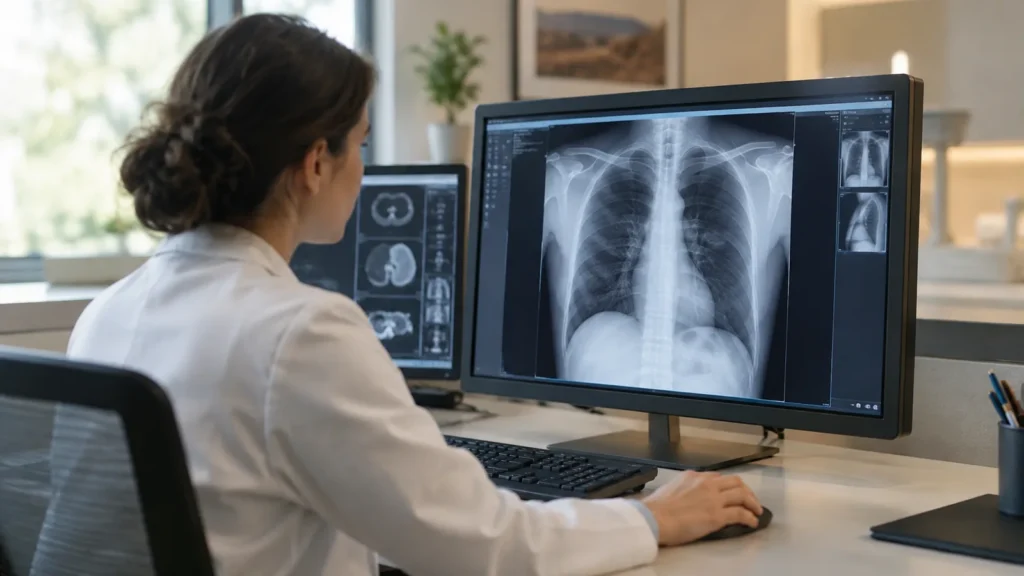
| Chest X-ray | age 15 and older |
| Blood test for tuberculosis (IGRA) | age 2 and older, if the country has a high TB rate |
| Blood test for syphilis | ages 18 to 44 |
| Test for gonorrhea (usually urine) | ages 18 to 24 |
| Vaccination review | all immigrants |
Ages and rules follow the CDC instructions for panel physicians. The doctor asks about medications, hospital stays, alcohol and drugs. Hiding a diagnosis makes no sense. Your records and the X-ray will show the picture anyway, and a false answer in the medical part causes bigger problems than the illness itself.
Pregnant applicants need the X-ray too. It can be postponed until after delivery, but you cannot immigrate without the image.
Vaccines for an immigrant visa
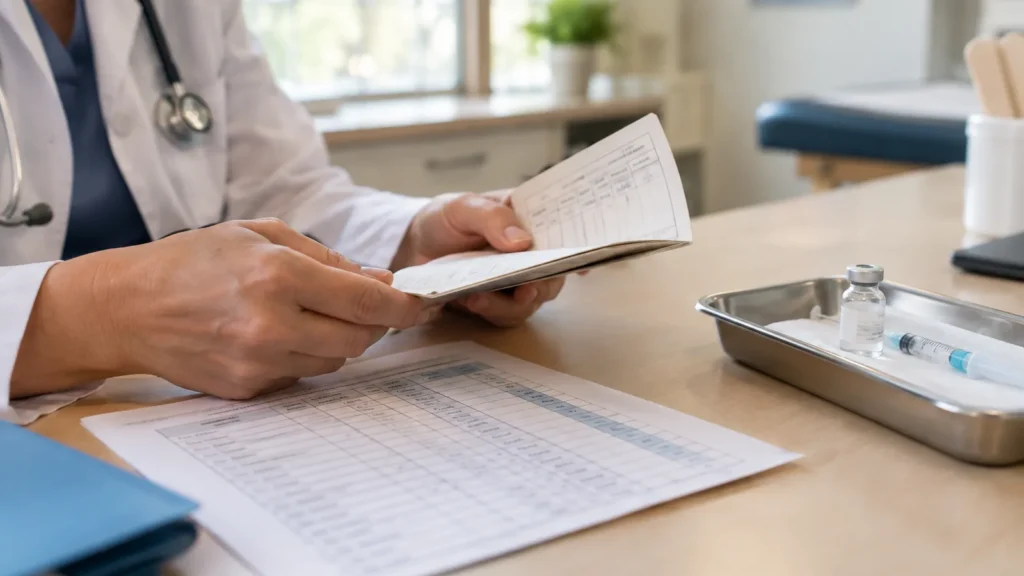
The law requires vaccines against measles, mumps and rubella, polio, tetanus and diphtheria, pertussis, Haemophilus influenzae type b (Hib) and hepatitis B. The CDC adds varicella, influenza, pneumococcal disease, rotavirus, hepatitis A and meningococcal disease. You do not get all of them. You get what fits your age, and the table is in the CDC vaccination instructions.
The COVID-19 vaccine is no longer required. USCIS stopped requiring it on January 20, 2025, and the CDC removed it from its list on March 11, 2025.
Only written records with the full date of each dose count. "I got everything as a child" does not. If you have no records, there are two options:
- take an antibody test, which is accepted for measles, mumps, rubella, hepatitis A and B, varicella and polio;
- get vaccinated by the panel physician. Before the visa, one dose of each missing vaccine is enough, and you finish the series in the US.
If a vaccine is not age-appropriate, is medically contraindicated, the interval has not passed or the vaccine is not available in the country, the doctor notes it and the visa is not affected. Refusing vaccines on religious grounds is different. That needs a separate USCIS waiver. The flu shot goes to everyone older than 6 months when the vaccine is available in the country, which means in season.
The doctor must hand you a copy of your vaccination record, Form DS-3025. Keep it. In the US it is useful for school and for the green card after a K-1.
Preparing for your immigrant visa interview? Review your documents and medical exam with a lawyer
Leave a request and we will contact you shortly
Exam result and how long it is valid
Most clinics work through the eMedical system, and the result goes to the embassy electronically. If a clinic works on paper, the result comes in a sealed envelope. You bring it to the interview and do not open it. For class A or class B tuberculosis, the clinic sends the result to the consulate itself.
Validity is set in 9 FAM 302.2-3(C):
- 6 months - the usual case, including most class B conditions;
- 3 months - for class B0 and B1 tuberculosis and for HIV infection.
A visa is issued for no longer than the exam stays valid. If four months of the exam are left, the visa will be valid for four months. If you do not enter the US in time, you have to repeat the whole exam with all the tests and the X-ray. This is one more reason not to take the exam before the interview letter arrives.
Form I-693 for a status change in the US
If you are already in the US and file for a green card through Form I-485, the exam is done by a civil surgeon, a doctor designated by USCIS. You can find one with the search tool on the Form I-693 page. The doctor records the result on Form I-693.
Under the current Form I-485 instructions, you file Form I-693 together with Form I-485. If it is missing from the package, the application can be rejected. USCIS charges no separate fee for Form I-693. The doctor sets the price.
How long Form I-693 is valid (Policy Manual, Volume 8, Part B, Chapter 4):
- a form signed by the doctor on or after November 1, 2023 stays valid for as long as the application it was filed with is pending;
- if the I-485 is withdrawn or denied, a new application needs a new Form I-693;
- if there is reason to think your health has changed, USCIS can request a new form even in a pending case.
The rule is softer for those who entered on a K-1. If the I-485 is filed within a year after the exam abroad and no class A condition was found, the whole exam is not repeated. You attach only the vaccination part of Form I-693 to the I-485, and only if the vaccines were not fully completed abroad. For help with the filing, see our page on changing status inside the US.
How much the exam costs and how long it takes
There is no government fee for the exam. The embassy and the clinic set the price according to local rates, and the applicant pays. Vaccines, the X-ray and lab tests are often billed separately, so the total depends on age and on how many vaccines are missing. The current price list is on the website of a clinic from the embassy's list.
The exam usually takes one or two visits. It takes longer when extra tests are needed. If the X-ray or symptoms point to tuberculosis, the clinic collects three sputum samples, and the cultures need at least 6 to 8 weeks to grow. Until they are ready, there is no result, and the interview may be postponed. So go for the exam right after the interview letter, not a few days before the interview.
Common delays and what to do
- Tuberculosis. If active tuberculosis (class A) is confirmed, you can leave only after treatment under direct observation by a doctor, which usually takes months. With class B1 no treatment is needed, but the exam is valid for 3 months, so you have to enter the US quickly.
- No vaccination records. Take an antibody test or get the vaccines at the clinic, sometimes over several visits. Look for old records at your local clinic and ask your parents early.
- Syphilis or gonorrhea. Until treated, both are class A. Gonorrhea is treated right at the clinic. After treatment the class changes to B, and the case moves on.
- History of psychiatric illness, alcohol or drug use. The doctor may refer you to a local specialist, and the applicant pays for it. Bring treatment and remission records right away.
- The exam expired before entry. You need a new full exam. If your interview was postponed, count six months from the exam date, not from the interview.
After the exam and the interview, you still have fees and entry to handle. For help with visa paperwork, see the pages on CR-1 visas for a spouse, IR visas for parents and children and K-1 visas for a fiancé(e).
Common questions about the immigration medical exam
Applying for a visa for your spouse or parents? We will prepare the documents before the interview
Leave a request and we will contact you shortly

How to Fill Out Form I-864 - Sponsor Requirements, Income and Instructions
Form I-864 (Affidavit of Support) is the sponsor's financial guarantee in US family-based immigration. The relative who files it promises to support the immigrant if they cannot support themselves, and proves their income is enough to back that up. Without it, a family-based green card does not get issued. Below is who has to file […]
How to Fill Out the DS-260 - Submission, Confirmation Page, and Unlock
The DS-260 is the online form for a US immigrant visa. Every applicant who gets a green card through a US consulate - family-based, employment-based, or through the Green Card Lottery - has to file one. The form is long, only in English, and everything in it gets checked against your documents and your answers […]

What the National Visa Center Does After Your I-130 Is Approved
The National Visa Center (NVC) is the State Department unit that handles a family-based immigrant visa case between I-130 approval and the interview at the consulate. If USCIS approved your petition and your relative lives outside the U.S., the next stage of the case runs through the National Visa Center. Step by step, this covers […]