











How to Get a K-1 Fiance Visa in the US - Steps, Requirements and Timeline

The K1 visa is the only US visa made specifically for the fiance or fiancee of a US citizen, so the couple can get married in America. From the outside it looks simple - petition, interview, move, wedding. In practice it takes a year or more, and most denials come not from a "bad application" but from small details the couple thought did not matter. Below is the full K1 visa process step by step, with requirements, forms, processing time, cost and the mistakes that cause the most trouble, for couples where one partner is a US citizen.
What a K1 visa is and who it is for
A K1 visa (fiance visa) is a nonimmigrant visa for the fiance or fiancee of a US citizen. It allows one entry into the country and gives 90 days to marry the exact person who filed the petition. After the wedding, the foreign fiance applies for adjustment of status and gets a green card without leaving the US. Miss the 90 days and the status ends, and there is no legal basis left to stay.
Only a US citizen can file the petition. A green card holder cannot use this route. Their future spouse has to go through a different category, F2A, and only after the marriage is registered.
A K1 visa is tied to one specific person. Marrying someone else and staying in the US on this visa is not an option.
And this visa is for couples who are not married yet. If you are already married, you need a spouse visa, CR-1 or IR-1, and there is a short comparison below.
Couples pick K1 when they want to marry in the US and stay together while the green card case moves forward. Every option for family-based immigration through marriage is on a separate page. If the wedding location does not matter to you, run the numbers for both routes. Sometimes marrying abroad and using a CR1 visa turns out faster and cheaper once you count the whole path to a green card.
K1 visa requirements - what USCIS checks
On paper the requirements are short. The trouble shows up in the details.
Met in person within the last 2 years
The couple must have met in person at least once in the 2 years before filing Form I-129F. Video calls and messages do not count, and neither does "we have known each other for ten years but have not seen each other lately." Proof of the meeting comes from plane tickets, passport stamps, dated photos together, hotel bookings.
There is an exception, granted for strict cultural or religious customs or for proven extreme hardship. It is rare. Do not build a plan around it without very strong evidence.
Both partners are free to marry
Any previous marriages on either side must be over and documented. A common mistake is having the divorce ruling but not the final decree, or a name spelled differently across documents. A consular officer catches these gaps fast, so check that the name matches letter for letter across the passport, certificates and forms.
The relationship is real
USCIS and the consular officer look for a genuine relationship, not one built for immigration. They check the message history, trips taken together, whether the partners know each other's families, wedding plans. Partners giving different answers to the same simple questions at the interview is one of the top reasons for K1 visa denials.
The petitioner's income
At the consulate the petitioner has to show they can support the future spouse. This usually means filing Form I-134 with proof of income at or above the federal poverty line. At the green card stage a stricter form, I-864, applies, with a 125% threshold. If the income is not enough, line up a joint sponsor early, not after the consulate asks for one. Starting October 1, 2026, USCIS only accepts the editions of I-864, I-864A and I-864EZ dated August 24, 2026 (08/24/26 on the form). In them, the sponsor consents to USCIS and the State Department pulling their credit reports and credit scores, and older versions will not work.
Planning a K1 visa? Check if your case qualifies before filing Form I-129F
Leave a request and we will contact you shortly
The K1 visa process step by step
The K1 visa process has two parts. First the petition goes through USCIS inside the US, then the case moves to consular processing in the country where the fiance or fiancee lives.
Step 1. File Form I-129F with USCIS
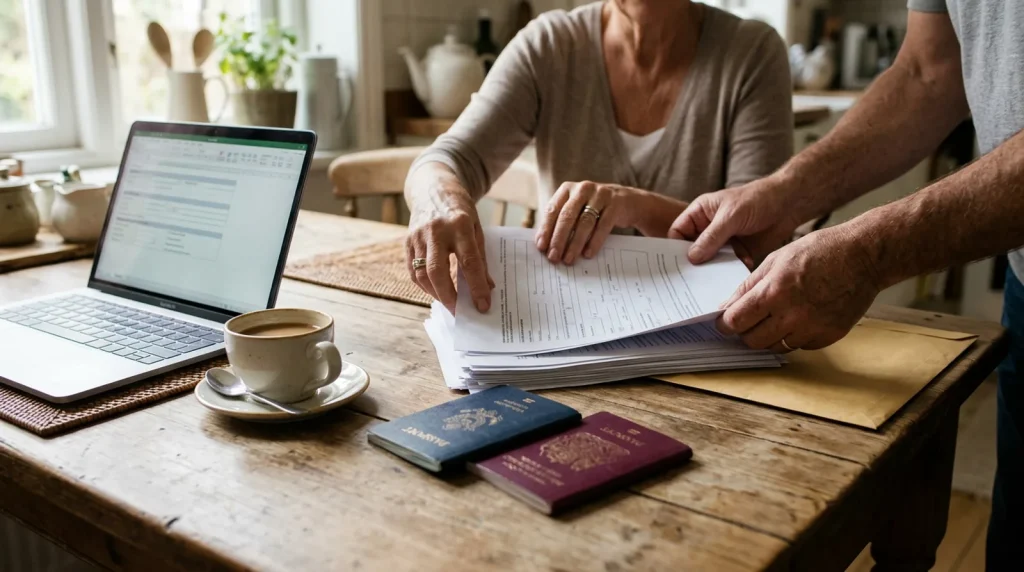
The US citizen files Form I-129F (Petition for Alien Fiance(e)) with USCIS. It can only be filed on paper, by mail. There is no online option for this form. The petition needs proof of the petitioner's citizenship, evidence of the in-person meeting within the last 2 years, statements from both partners that they intend to marry within 90 days, photos, and documents on any past divorces.
An approved petition is not a visa yet. USCIS only confirms the paperwork meets the formal conditions. The consular officer decides the rest.
Step 2. NVC and the case moves to a consulate
The approved petition goes to the National Visa Center (NVC), gets a case number, and is sent to the US embassy or consulate in the fiance's or fiancee's country. The one thing not to miss here is the instructions email, since each post has its own appointment rules and document list.
Since November 1, 2025, the NVC schedules the interview in the country where the applicant lives. You can find which post covers your country in the list of posts on travel.state.gov.
Step 3. DS-160, documents and the interview
The fiance or fiancee fills out the online DS-160 form (K visas use the nonimmigrant visa application), pays the consular fee, gets a medical exam from a panel physician on the embassy's list, and puts together the document package. That means a valid passport, birth certificate, a police certificate, records of any past marriages, evidence of the relationship, and the petitioner's financial documents. The official checklist is on the K1 visa page at travel.state.gov.

The interview decides everything. The officer looks at both the documents and the relationship itself. Answer for yourself, honestly, and without contradicting the petition. Rehearsed answers are easy to spot. Some cases go to administrative processing under section 221(g) after the interview. That is not a denial, but the wait can stretch into weeks or months.
Step 4. Entry to the US and marriage within 90 days
A K1 visa allows one entry. From that day you have 90 days to marry the petitioner, and that window cannot be extended. A courthouse ceremony counts the same as a wedding with a hundred guests. Immigration only cares that the marriage is legally registered.
Step 5. Adjustment of status and the green card
After the wedding, the foreign spouse files Form I-485 for adjustment of status along with Form I-864 from the citizen spouse. Most people file Form I-765 for work authorization and Form I-131 for advance parole at the same time. Advance parole is what lets you leave the US while the green card application is pending. Leaving without it means abandoning the adjustment of status application. There is more detail on this stage on our adjustment of status page.
Since the marriage will be under 2 years old when the green card is issued, it comes as a conditional card, valid for 2 years. In the 90 days before it expires, both spouses file Form I-751 to remove the conditions.
Form I-129F - where most mistakes happen
Form I-129F starts the whole process, and it is also where most problems begin.
- Consistent details everywhere. Names, dates, addresses for the last 5 years, marriage history, all of it needs to match across I-129F, the later DS-160, and the supporting documents. A different spelling of a name in the petition and in the passport is a classic trigger for a Request for Evidence (RFE).
- The story of how you met. The section about how the relationship started and developed gets read closely. It should hold together as one timeline, with dates of trips and photos to back it up.
- Earlier petitions. If the US citizen has filed Form I-129F before, limits on how often and how many times apply under IMBRA, and certain past convictions must be disclosed. Hiding this does not work. The consular officer sees it.
- A complete package. Leave out the statement of intent to marry or a photo, and the petition comes back or gets an RFE, adding months. Since August 2026, USCIS can deny the petition outright, without an RFE, if required evidence is missing. Hoping "they will ask for whatever is missing" no longer works.
In our experience, the most frustrating K1 visa delays are not complicated legal questions. They are RFEs over small I-129F mistakes that could have been caught before filing.
Preparing your Form I-129F petition? We will review the package before you file
Leave a request and we will contact you shortly
K1 visa processing time
Processing time depends on USCIS workload and the specific consulate. The numbers below are estimates for late 2026 based on practice, not a promise.
| Stage | Estimated time |
|---|---|
| USCIS review of Form I-129F | 6-9 months |
| NVC processing and transfer to the consulate | 4-8 weeks |
| Wait for the interview and visa issuance | 1-3 months, depends on the consulate |
| Total to entry into the US | about 9-14 months |
| Green card after the wedding (Form I-485) | another 8-14 months, you can live and work in the US during this time |
USCIS publishes official processing times for Form I-129F in the Case Processing Times section. If your case runs past the posted time, you can file an inquiry with USCIS.
K1 visa cost
The required government fees for the K1 visa route, not counting lawyers, translations or travel:
| Fee | Amount |
|---|---|
| Form I-129F petition (USCIS) | $675 |
| K visa consular fee | $265 |
| Medical exam | $200-500, depends on country and clinic |
| Adjustment of status, Form I-485, after the wedding | $1,440 paper filing, $1,390 online |
| Total government fees | from about $2,500 per applicant |
USCIS fees follow the official fee schedule, and the consular fee is listed on travel.state.gov. On top of that add document translations, certificates, apostilles and flights. In total government fees, the K1 visa costs more than the CR1 route, mostly because adjustment of status is paid separately once you are already in the US.
Children of the fiance or fiancee - the K2 visa
Unmarried children of the fiance or fiancee under 21 get a K2 visa and can enter with the parent or later. They must be listed on Form I-129F from the start. Adding them after approval is not possible. After the parent's wedding, the children also file for adjustment of status.
K1 visa vs CR1 visa - which one to choose
If the couple has not decided which route to take:
| Factor | K1, fiance visa | CR1/IR1, spouse visa |
|---|---|---|
| Where the wedding happens | in the US, within 90 days of entry | before the process starts, in any country |
| When the couple reunites | usually a few months sooner | later, but with full status on entry |
| Status on arrival | nonimmigrant, green card comes later | green card almost right away |
| Work authorization | after a separate permit (EAD) | immediately after entry |
| Total government fees | higher | lower |
Couples who want to reunite fast and marry in the US usually pick K1. If working right away and traveling freely matter more, CR1 wins. There is a full breakdown of the spouse visa in our article on the CR1 and IR1 visa.
Why K1 visa applications get denied
- The 2-year meeting is not proven. No tickets or photos saved, no passport stamps. Start collecting proof of every trip from the beginning of the relationship.
- Contradictions at the interview. Partners give different answers to simple questions, where you met, when you last saw each other, who was at the engagement. Go over the relationship timeline together before the interview, without memorizing a script.
- Past marriages not closed out. No final divorce decree, or the name on it does not match.
- A weak financial case. The petitioner's income is below the threshold and there is no joint sponsor.
- A big gap between the partners. Age, language, a short relationship history. It is not a bar on its own, but the consular officer looks more closely, and these couples need more evidence of a genuine relationship.
- Mistakes and omissions on the forms. Especially about past visa denials, criminal history and earlier petitions. Leaving something out always comes to light, and a fixable issue turns into a misrepresentation finding.
A word on 221(g) after the interview. It is a yellow light. The officer needs more documents or time. Send exactly what was requested, quickly and completely. Sending everything at once does not help.
Frequently asked questions about the K1 fiance visa
A K1 visa case is won with preparation, relationship evidence gathered early, careful forms, and honest answers at the interview. If you have had a denial before, documents from more than one country, or an unusual set of circumstances, talk to an immigration lawyer before filing the petition, not after an RFE arrives. We work through cases like this regularly. More detail is on our K1, K2, K3 and K4 visas page.
Had a visa denial or an unusual case? Talk to an immigration lawyer about your K1 visa
Leave a request and we will contact you shortly

How to Get an L-1 Visa in the US and an L-2 Visa for Your Family

How to Get an E-2 Visa in the USA - Who Qualifies and How to Apply
How to Get a CR1 or IR1 Visa for Your Spouse - Petition, Timeline and Cost