











How to Get a CR1 or IR1 Visa for Your Spouse - Petition, Timeline and Cost

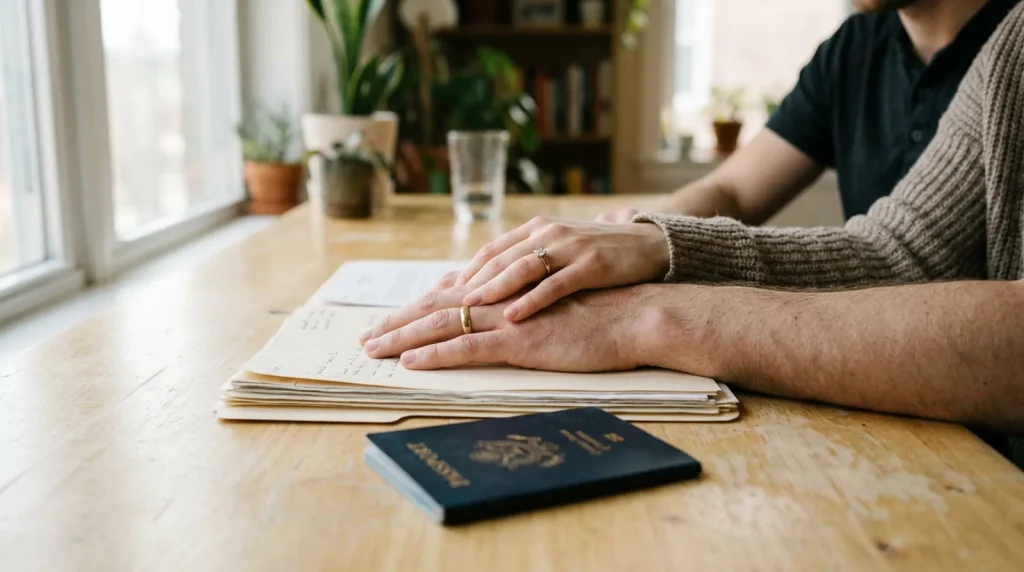
If you are already married to a US citizen, your route to America is the CR1 or IR1 spouse visa. The spouse enters as a permanent resident right away, can work from day one, and does not have to wait inside the country for a green card. The trade-off is time. The case goes through Form I-130, the National Visa Center and a consulate, and the whole thing usually takes more than a year. Below is the full process step by step, real timelines and costs, the difference between CR1 and IR1, and the mistakes that add months to a case.
CR1 vs IR1 - what these spouse visas are and how they differ
CR1 and IR1 are immigrant visas for the husband or wife of a US citizen, and people often just call the whole route the marriage green card process, no matter which category applies. The result is the same for both. The spouse enters as a permanent resident and gets the plastic green card in the mail within the first few months after arrival. CR1 vs IR1 comes down to one date, your wedding day.
| CR1 (Conditional Resident) | IR1 (Immediate Relative) | |
|---|---|---|
| Marriage age on entry | under 2 years | 2 years or more |
| Green card | conditional, 2 years | permanent, 10 years |
| Extra step | removing conditions, Form I-751 | not needed |
| Work authorization | immediately | immediately |
You do not choose the category yourself. It is set by the wedding date. Both routes use the same documents, and if the marriage turns 2 years old during processing, CR1 automatically becomes IR1. More detail on each category is on our pages about the CR1 and CR2 visa and the IR visa.
This route is only for spouses of US citizens. If the husband or wife holds a green card instead, category F2A applies, with its own timeline and quotas. And it is only for couples who are already married. If you have not had the wedding yet, look at the K1 fiance visa instead. There is a comparison of both routes below.
Spouse visa USA requirements - who can apply
- The petitioner is a US citizen. They file the petition and later act as the financial sponsor.
- The marriage is legally registered. A marriage from any country works, as long as it is valid where it was performed. A certificate issued outside the US carries the same weight as an American one. A religious ceremony without civil registration does not count.
- The marriage is genuine. Officers look at shared history, housing, finances, trips, photos, messages, children. Marriage fraud is a federal crime in the US, and once USCIS finds a marriage fraudulent, no future immigration petition for that person will be approved.
- Past marriages are closed. Divorces and widowhood need documents, and the names on them must match the passports.
- The sponsor's income. Form I-864 requires income at or above 125% of the federal poverty line for the household size. Short on income, add a joint sponsor or count assets instead. Starting October 1, 2026, only the editions of I-864, I-864A and I-864EZ dated August 24, 2026 (08/24/26 on the form) are accepted. In them, the sponsor consents to USCIS and the State Department pulling their credit reports and credit scores.
Want to bring your husband or wife to the US? Check your documents before filing Form I-130
Leave a request and we will contact you shortly

The CR1/IR1 visa process step by step
Step 1. File Form I-130 with USCIS
The US citizen files Form I-130 (Petition for Alien Relative) online or by mail. It comes with the marriage certificate, proof of citizenship, documents closing out any past marriages, and evidence that the relationship is genuine. An approved I-130 confirms the family relationship, but it is still not a visa.
Step 2. NVC, Form DS-260 and Form I-864
The approved petition goes to the National Visa Center (NVC). There you pay the visa fee and the affidavit of support review fee, complete the immigrant visa application DS-260, upload civil documents (certificates, a police certificate) and Form I-864 with the sponsor's tax returns. Once the file is complete, the NVC marks the case documentarily qualified and places it in line for an interview.

Most of the delay in the whole process happens right here, and usually by the applicants' own doing. Documents get uploaded piecemeal, certificates expire while waiting, and replies to NVC requests take weeks. This is the one stage that depends entirely on you, so it pays to put the full package together in advance.
Step 3. The consulate interview
Before the interview, the foreign spouse gets a medical exam from a panel physician on the embassy's list. The consular officer reviews the documents and asks about the marriage, how you met, how you live, what you are planning. The US citizen spouse does not usually need to attend, but it can help in less straightforward cases.
The interview takes place in the country where the foreign spouse lives. The NVC has worked this way since November 1, 2025. You can look up your post in the list of consulates on travel.state.gov.
The outcome is a visa in the passport, a denial (rare with a complete package), or administrative processing under section 221(g), when the officer needs more documents or time.
Step 4. Entry and the green card
An immigrant visa is valid for no more than 6 months, sometimes less depending on the medical exam date. Before entry, there is a USCIS immigrant fee to pay. The entry stamp in the passport confirms permanent resident status right away. The plastic card arrives by mail within a few weeks to a few months. You can work and apply for a Social Security number immediately, with no separate work permit needed.
CR1 visa processing time
This is not a fast route. The numbers below are estimates for late 2026 based on practice, not a promise.
| Stage | Estimated time |
|---|---|
| USCIS review of Form I-130 for a citizen's spouse | 12-16 months |
| NVC, fees, DS-260, complete package | 2-4 months, largely up to you |
| Consulate queue and interview | 2-4 months |
| Total to the visa | about 16-22 months |
I-130 timelines vary. USCIS spreads cases across service centers, and two similar cases can differ by six months. Official estimates are in USCIS Case Processing Times, and case status shows up in CEAC. Spouses of US citizens are not subject to visa quotas, so the wait here is purely logistical, not a queue for a priority date like the family preference categories.
In 2026, policy changes affected timelines for some applicants. From January 21 to August 21, 2026, the State Department paused immigrant visa issuance for nationals of 75 countries, and spouse visas were not exempt. A court vacated the pause on August 21, but the government has appealed and asked for the ruling to be put on hold, and some immigrant visa interviews through the end of September were rescheduled. Check the State Department's page on this pause before filing. Separately, an entry restriction under a presidential proclamation affects nationals of 39 countries. See the State Department notice for the current list.
Case stuck at the NVC or the consulate? Let's find out what is holding it up
Leave a request and we will contact you shortly
CR1 or IR1 visa cost
Government fees per applicant, not counting lawyers or translations:
| Fee | Amount |
|---|---|
| Form I-130 petition | $675 paper, $625 online |
| DS-260 visa fee | $325 |
| I-864 review at the NVC | $120 |
| USCIS immigrant fee (after the visa) | $235 |
| Medical exam | $200-500 |
| Total government fees | from about $1,600 |
USCIS fees follow the official fee schedule, and visa fees are listed on travel.state.gov. The K1 fiance visa route with adjustment of status afterward costs more, from about $2,500 in government fees alone.
The conditional green card and Form I-751
If the marriage is under 2 years old on entry, the green card is conditional, valid for 2 years. In the 90 days before it expires, both spouses file a joint Form I-751, with fresh evidence of shared life, such as joint accounts, a lease or mortgage, insurance, children, photos.

Missing the I-751 window is a common and costly mistake. The status ends automatically, and the person ends up in removal proceedings over a forgotten date. Set a reminder the day you receive the conditional card.
A divorce before the conditions are removed is not automatically the end of the road. Form I-751 can be filed alone, requesting a waiver of the joint filing requirement, but proving the marriage was genuine takes more evidence in that case.
CR1 vs K1 - which visa should you choose
| Factor | CR1/IR1 | K1 |
|---|---|---|
| Status on entry | permanent resident | nonimmigrant, green card later |
| Work authorization | immediately | after a separate permit |
| Travel abroad | freely | only with advance parole |
| When the couple reunites | later | usually a few months sooner |
| Total government fees | about $1,600 | about $2,500 |
| Where the wedding happens | before the process starts, anywhere | in the US, within 90 days |
In our experience, if the couple is already married or ready to marry ahead of time, CR1 is almost always the more sensible choice. K1 wins when meeting up quickly matters most and the couple wants to marry in the US. There is a full breakdown of the fiance visa in our article on the K1 visa.
If your spouse is already in the US - adjustment of status instead of a consulate
When the foreign spouse is already in the US on a work, study or other valid visa, the consular route is not necessary. Form I-130 is filed together with Form I-485 inside the country, no travel required. This is adjustment of status. Each path has its upside. With adjustment of status, the couple stays together for the whole process. With the consular route, the spouse arrives with full immigrant status and fewer travel restrictions right away. Which one fits depends on the current status, entry history and the couple's plans.
Be careful with marrying soon after entering on a tourist visa. If someone entered on a B1/B2 visa already planning to stay and marry, consular officers treat that as misrepresentation. Weddings and filings within the first 90 days after entry draw extra scrutiny. Since May 2026, USCIS has described adjustment of status as a discretionary benefit and separately weighs post-entry conduct that does not match the purpose of the visa. If your timeline looks like this, get advice before you file anything.
Where cases lose time and get denied
- Weak evidence of the marriage. The couple lives in different countries and there are few joint documents. Start collecting the history early, such as tickets, dated photos, money transfers, shared paperwork.
- Mismatched documents. Transliterated names, maiden names, errors on certificates. Anything that does not match letter for letter needs an explanation.
- A slow NVC stage. The package takes months to assemble, and the case just sits there the whole time.
- Expired certificates. Police certificates and medical exams have a limited shelf life. Get them too early and they expire before the interview.
- An underpowered I-864. A sponsor with unreported income or no tax returns is a stop sign. Line up a joint sponsor early, not after the consular officer asks.
- Omissions. Past visa denials, deportations and status violations are visible to the officer. Hiding them does not work, and a misrepresentation finding is worse than the original problem.
Frequently asked questions about the CR1 and IR1 spouse visa
CR1 and IR1 are the most predictable route into the US through marriage, with no quotas or lottery and full status from day one. What derails it is time lost over small things like an incomplete package, expired certificates and silence in response to NVC requests. If your history includes a past denial, a status violation, or anything out of the ordinary, get it reviewed before filing the petition, while there is still room to set it up correctly.
Had a denial or a complicated history? Talk to an immigration lawyer about your spouse visa
Leave a request and we will contact you shortly

How to Get an L-1 Visa in the US and an L-2 Visa for Your Family

How to Get an E-2 Visa in the USA - Who Qualifies and How to Apply

How to Get a K-1 Fiance Visa in the US - Steps, Requirements and Timeline