











How to Get a Green Card Through the EB-5 Investor Program


EB-5 is a US immigration category for investors. You invest money in a new business that creates at least 10 full-time jobs, and you, your spouse, and your children under 21 get a conditional green card for two years. Below: how much to invest, how a direct investment differs from a regional center project, current USCIS fees and timelines, and what changed in 2026.
What EB-5 is and what status it gives
Congress created the EB-5 program in 1990 to attract foreign capital and create jobs. An investor puts money into a new commercial enterprise in the US and files a petition alone, without an employer and without relatives who are US citizens. USCIS explains the requirements on its page About the EB-5 Visa Classification.
A conditional green card gives permanent resident status from day one. With it you can live in the US and work for any employer or for yourself. The status gives you these rights, not the immigrant visa - the visa is only for entry. In the 90 days before the second anniversary of the status, the investor files Form I-829, and if the requirements are met, the conditions are removed for the investor and for the family members included in the petition.
Citizenship follows the general rule - you apply after five years with a green card. The conditional years count toward that period.
Who a green card through investment fits
EB-5 fits people who have at least $800,000 in lawful funds beyond project fees and expenses, and who can keep that money invested for at least two years with no guarantee it comes back. It's usually business owners and investors who want a green card for the whole family without a US employer. The conditional green card goes to the investor together with a spouse and unmarried children under 21.
If you already run a business abroad, compare EB-5 with transferring to a US office through an L-1 visa and an L-2 visa for the family. If you're still choosing between E-2, L-1, and EB-5, start with an overview of US visas for business and investors, and if the investment amount doesn't work for you, look at other lawful ways to move to the US. There's also a path without a business investment - the Gold Card, where after an I-140G application with a $15,000 fee and a background check you pay a non-refundable $1 million contribution, and the green card is issued in the EB-1 or EB-2 category.
Considering a green card through investment? We'll check if EB-5 fits you and how much you need
Leave a request and we will contact you shortly

Direct investment or a regional center
USCIS splits investors into standalone investors and regional center investors. This changes the petition form and how jobs are counted, and the processing times for the two forms differ by more than double. The times in the table are USCIS medians for the quarter, so half of petitions were processed faster and half slower.
| Direct investment | Regional center | |
|---|---|---|
| Petition | I-526 | I-526E |
| Jobs | direct only | up to 90% indirect |
| Median, April-June 2026 | 32.3 months | 13.6 months |
With a direct investment you put money into your own or a partner's company and take part in running it, daily or by setting company policy. You don't have to run day-to-day operations yourself. Only direct jobs count - people on the payroll of the company itself or its subsidiaries with 100% ownership.
In a regional center project, up to 90% of jobs can be indirect, created outside the company. If a construction project runs under two years, indirect jobs can't be more than 75% of the total. USCIS keeps a list of approved centers and a separate list of terminated ones on its regional centers page. Check both.
If you don't need a green card and want to run your own business in the US, look at how to get an E-2 visa. It's temporary and available only to citizens of countries that have a trade treaty with the US - check the official treaty country list before you plan around it.
EB-5 requirements - amount, jobs, and lawful money

The base amount is $1,050,000. The reduced amount, $800,000, depends on where the project is and what kind it is.
| Project | Minimum investment |
|---|---|
| TEA - rural area | $800,000 |
| TEA - unemployment at least 150% of the national average | $800,000 |
| Regional center infrastructure project | $800,000 |
| All other projects | $1,050,000 |
These amounts apply to petitions filed before December 31, 2026. From January 1, 2027 the law indexes the base amount for inflation, rounded down to the nearest $50,000, and the reduced amount stays at 75% of the base. DHS has to publish the new figures in the Federal Register. As of September 2026 they aren't there yet.
A regional center doesn't lower the amount by itself. The $800,000 applies only to a project in a TEA zone or a regional center infrastructure project. There's no separate higher amount right now for high-employment areas.
The money has to be at risk. A guaranteed return or a contract right to demand the money back takes away its status as capital. You keep the investment in the project for at least two years, and project administrative fees are paid on top of the minimum amount. Add USCIS fees and living costs for the first months - there's a full breakdown in our article on how much money you need to move to the US.
You need at least 10 jobs, and USCIS counts them strictly. These are full-time positions of at least 35 hours a week in the new commercial enterprise, for US citizens, green card holders, and other immigrants with work authorization. The investor, their spouse, and children don't count, and neither do workers on nonimmigrant visas like H-1B.
Source of funds - proving the money is lawful
USCIS checks the whole path of the money, from the original source of income to the transfer into the project. You also have to show that the money for administrative fees is lawful, and name everyone who sent money to the US on the investor's behalf. Common sources are business profit, a property sale, dividends, or inheritance. Since May 14, 2022 the law directly allows gifted and borrowed money, as long as the gift or loan is genuine and not covering up an unlawful source. Then the origin of the money is proven through the giver or the lender, if the lender isn't a bank. A debt secured by the assets of the company receiving the investment doesn't count as capital.
What's usually in the package:
- personal tax returns for the last 7 years (for petitions filed since May 14, 2022);
- bank statements and transfer confirmations;
- sale contracts for a business, property, or other assets;
- company registration and tax documents;
- records of court judgments and debt collection claims.
The 2022 EB-5 reform law made the source-of-funds check mandatory. The investor is also checked against the OFAC sanctions list, and checks, including ones outside the US, are paid for by the EB-5 Integrity Fund.
How to get an EB-5 green card - steps and forms
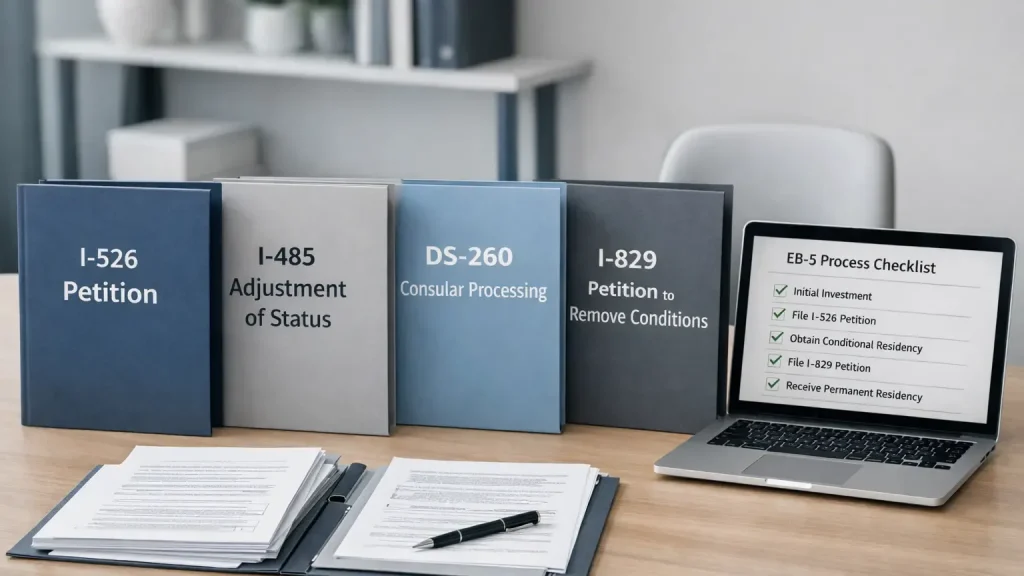
USCIS lays out the whole process on its EB-5 Immigrant Investor Process page. In short:
- Choose a project and invest the money.
- File petition I-526 or I-526E.
- File I-485 in the US, or get an immigrant visa through a consulate with DS-260.
- Get a conditional green card for two years.
- File I-829 in the 90 days before the second anniversary of the status.
Petition I-526 or I-526E
By the time you file, the money is already invested or in the process of being invested. Holding it in an escrow account until you get the green card is fine. A standalone investor files I-526. A regional center investor files I-526E. USCIS rejects an I-526 petition where the investment went through a regional center.
At this stage USCIS checks the source of the money, the project structure, the business plan, and the job count. A regional center project is approved separately, on Form I-956F, and that approval isn't reopened in investor petitions unless the project changes materially. An approved petition doesn't give you status yet. It opens the visa stage.
I-485 in the US or DS-260 through a consulate
If the investor is in the US lawfully and a visa is available right away, I-485 can be filed together with I-526 or I-526E while the petition is pending, or after it's approved. While it's pending you can request work and travel authorization. A change of status inside the US is up to USCIS discretion, and a new DHS public charge rule applies to I-485 filed since September 18, 2026.
Anyone living outside the US gets an immigrant visa at a consulate through Form DS-260 after the petition is approved, usually in the country where they live. Conditional status starts on the day of entry on that visa, or, for a status change inside the US, on the day I-485 is approved.
Conditional green card and removing conditions with I-829
I-829 is filed in the 90 days before the second anniversary of the conditional status. That date is also the expiration date printed on the green card itself. Filing before that window opens risks a rejection. USCIS checks that the investment stayed in place. The jobs don't have to be fully created by this point. It's enough to show they'll exist within a reasonable time, usually within a year of the second anniversary.
Being late is costly. If I-829 isn't filed on time, USCIS terminates the conditional status and the person faces removal. A late filing is accepted only with a written explanation of good cause, and it's up to USCIS. After filing, the receipt notice extends the green card for the period stated on it. Since January 2023 that's been 48 months. Once I-829 is approved, the investor and family stay permanent residents without conditions.
Filing an I-526E petition? We'll check your source of funds and evidence before you submit to USCIS
Leave a request and we will contact you shortly
How much EB-5 costs and how long it takes in 2026
Fees from the USCIS G-1055 fee schedule, updated 09.09.26:
| Form | Fee |
|---|---|
| I-526 | $3,675 |
| I-526E | $3,675 plus $1,000 to the EB-5 Integrity Fund for the initial petition |
| I-829 | $3,750 |
| I-485, applicant over 14 | $1,440 on paper, $1,390 online |
Each form is paid separately. In a proposed rule from October 23, 2025, DHS wants to raise the fee for I-526 and I-526E to $9,625 and for I-829 to $7,860. There's no final rule as of September 2026.
The I-829 median for April-June 2026 was 12.8 months. Add the petition, the visa stage, and the two years of conditional status, and the path to an unconditional green card takes several years. At the end of that quarter, 11,192 I-526E petitions and 8,244 I-829 petitions were still pending. The law requires USCIS to prioritize petitions for rural projects, and among I-526E petitions filed from October 2025 through June 2026, 2,624 of 4,986 were rural.
The second part of the timeline is the visa. EB-5 gets 7.1% of employment-based immigrant visas, around 10,000 a year with family members. 32% of those are reserved - 20% for rural areas, 10% for high-unemployment areas, and 2% for infrastructure projects. The per-country limit is shared across family and employment categories at 7%, which is 28,862 visas in fiscal year 2026.
In the Visa Bulletin for September 2026, every EB-5 row is marked current for most countries. The only backlogs are in the unreserved category for China (dated 01DEC16) and India, marked "U" for no visas available. As of June 2026, 9,553 approved petitions were waiting for a visa, 9,549 of them from people born in China. The State Department warns that dates can move backward if demand grows, so check the latest bulletin before you file.
EB-5 risks and denials
USCIS doesn't publish reasons for denials, only the number of decisions. For April-June 2026, I-526E had 687 approvals and 217 denials. The risk areas are clear from the law and the Policy Manual:
- the source and path of the money;
- the capital itself, if there's a guaranteed return or a right to demand the money back;
- the job-creation plan;
- material changes to the project after filing.
Since August 5, 2026 USCIS can deny a petition without a request for evidence if the required proof isn't attached to it (Policy Alert PA-2026-05). Counting on filling gaps later through a request for evidence is now risky.
Pause on immigrant visas and Proclamation 10998
From January 21, 2026 to August 21, 2026 the State Department stopped issuing immigrant visas to nationals of a specific list of countries. A court lifted the pause on August 21, 2026, but the case is still going. The government filed an appeal on September 10, 2026 and asked for a stay on September 14, 2026. The pause covered visa issuance at consulates, meaning the DS-260 path, so check the State Department page before you file DS-260.
Proclamation 10998 has been in effect since January 1, 2026 and suspends immigrant visa issuance, including EB-5, for nationals of a separate, shorter list of countries. Check the State Department notice for the current list before you rely on any timeline.
How to choose an EB-5 project and vet a regional center
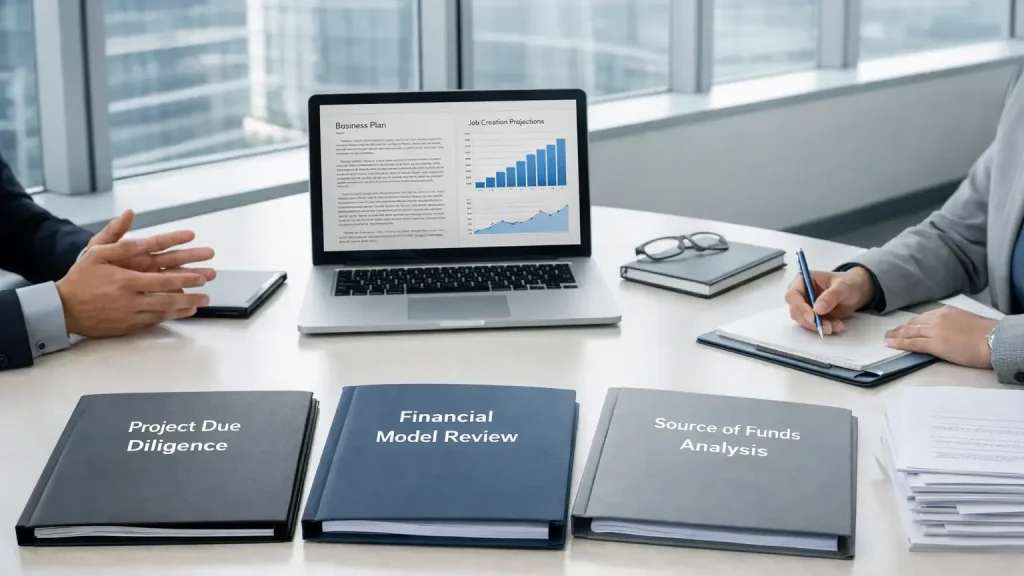
The money goes in before or with the petition, so you vet the project before you transfer it. For regional centers, a lot is visible from USCIS filings. A project is approved on Form I-956F. The center files an annual report on Form I-956G, gets reviewed at least once every five years, and pays $20,000 or $10,000 a year into the EB-5 Integrity Fund. Middlemen who sell projects register with USCIS on Form I-956K.
Before you invest, check:
- the center is on the USCIS list of approved centers and not on the terminated list;
- the middleman is registered on Form I-956K;
- the center has completed projects and past investors who had conditions removed through I-829;
- the contract has no guaranteed return and no right to demand the money back;
- the financial model, job count, and the management team's track record are clear.
Gather your own source-of-funds documents before you transfer money too. An incomplete petition can now be denied without a chance to add evidence. Our EB-5 visa support can help you check the project and the money trail before you file.
Frequently asked questions about the EB-5 green card
Choosing an EB-5 project? We'll check the regional center and the contract before you wire money
Leave a request and we will contact you shortly

What It Takes to Get a US Tourist Visa (B1/B2)
The US tourist visa is called B-1/B-2. It is one visa for two kinds of trips, business and pleasure. Getting it is harder than travel forums make it sound, and easier than visa agencies claim when they sell invitation letters and proof-of-income packages. Below is what the visa actually allows, what documents the State Department […]
How Much Does It Cost to Move to the USA - Expenses, Salaries, and Budget

How to Fill Out the DS-260 - Submission, Confirmation Page, and Unlock
The DS-260 is the online form for a US immigrant visa. Every applicant who gets a green card through a US consulate - family-based, employment-based, or through the Green Card Lottery - has to file one. The form is long, only in English, and everything in it gets checked against your documents and your answers […]

How to Fill Out the DS-160 Form - Step-by-Step Guide and Common Mistakes
DS-160 is the online application for a US nonimmigrant visa. Every applicant files a separate form, including infants, whether they are applying for a tourist visa, a student visa, a work visa or a K-1 fiance visa. The State Department estimates the form takes 90 minutes to complete, and that assumes you already have all […]