










What It Takes to Get a US Tourist Visa (B1/B2)


Need a US tourist visa? Let us assess your chances before you apply
Leave a request and we will contact you shortly
The US tourist visa is called B-1/B-2. It is one visa for two kinds of trips, business and pleasure. Getting it is harder than travel forums make it sound, and easier than visa agencies claim when they sell invitation letters and proof-of-income packages. Below is what the visa actually allows, what documents the State Department really asks for, how the process works from the form to the stamp in your passport, and why most applications get refused.
What the B1/B2 visa allows
B-1 covers business trips. B-2 covers tourism, medical treatment, and visits to family. Most applicants get a combined B-1/B-2 visa, which covers both purposes at once. It is one visa with two annotations, not two separate visas.
A visitor visa lets you take a vacation, visit friends and relatives, get medical treatment, join negotiations or conferences, close a business deal, take part in a lawsuit, or compete as an amateur in a sports or music event without pay. You can even take a short course for fun. The State Department gives the example of a two-day recreational cooking class.
What you cannot do is written into the law itself. INA 101(a)(15)(B) excludes from category B anyone coming to study or to perform skilled or unskilled labor. The ban on study and work is not a minor rule buried in guidance somewhere. It is part of the legal definition of the visa.
A few details trip people up:
- "Business" in B-1 does not mean employment. Regulation 22 CFR 41.31(b)(1) states that business means conventions, consultations, and business negotiations. It does not include local employment or labor for hire. Construction and installation work count as local employment under the same rule.
- You cannot be paid from a US source. Guidance to consular officers at 9 FAM 402.2-5(F) bars any salary or other payment from a US source. You can only be reimbursed for actual travel costs, such as transportation, lodging, and meals.
- There is one exception, academic honoraria. These are allowed if the activity at one institution lasts no more than 9 days, and you have not received such payments from more than 5 institutions in the past 6 months.
- Giving birth in the US cannot be the purpose of the trip. This is a separate rule, covered later in this article.
- A degree program needs a student visa, not a B-2. A short personal-enrichment course is fine, and the visa gets the annotation STUDY INCIDENTAL TO VISIT.
One grey area comes up often - working remotely for your foreign employer from a hotel room in Miami. There is no direct permission for this in the regulations. The closest guidance is the Matter of Hira standard. The activity is acceptable if your employer's main place of business, and its profits, stay outside the US. This is a grey area, and I would not present it to a client as a safe plan.
Requirements - what the consular officer actually checks
The main requirement for a US tourist visa is not about money or a hotel reservation. It is about your intent to return home.
INA 214(b) sets up a presumption. Every foreign national is presumed to be an immigrant until they prove otherwise, first to the consular officer when applying, then to the CBP officer at the border. The presumption applies twice, and most articles on this topic miss that second part.
Under 9 FAM 402.2-2(B), the officer needs to see three things:
- you have a residence abroad that you do not intend to give up;
- your trip is limited to a specific period of time;
- your purpose is a legitimate business or pleasure activity.
The wording is strict. If even one of these is not met, the officer must refuse the visa, not may refuse. And "temporary" does not mean "short". The FAM states that a stay longer than six months or a year is not, on its own, a reason to refuse, as long as the stay has a clear end date.
There is no fixed list of what counts as ties to your home country. The State Department mentions your job, your home, and your relationships with family and friends as examples, not as a checklist. One tactic that does not work is leaving a spouse or child behind as proof you will return. The FAM addresses this directly. That alone does not remove the officer's doubt.
Planning to apply for a US tourist visa? Talk to an immigration attorney about your situation
Leave a request and we will contact you shortly
Documents - four required, everything else optional
Only four documents are strictly required: a valid passport, the DS-160 confirmation page with its barcode, the fee payment receipt, and a photo uploaded to the application. Everything else is described by the State Department as "may be required", and the exact list depends on the embassy where you apply.
The officer can also ask for proof of your travel purpose, your intent to leave, and your ability to pay for the trip. Regulation 22 CFR 41.31(a)(3) requires "adequate financial arrangements", enough funds for the trip and the return home. There is no minimum bank balance written into any rule. The claim that you need to show $5,000 per person is a myth that keeps circulating online.
One line is worth quoting in full, because a whole industry is built around ignoring it.
Visa applicants must qualify based on their ties abroad/to their home country, rather than assurances from U.S. family and friends. A letter of invitation or Affidavit of Support is not needed to apply for a visitor visa.
An invitation letter or Affidavit of Support from relatives is not required and does not affect the decision. You can bring one to the interview, but it will not help your case.
The one exception is medical treatment. There the rules do list specific documents: a diagnosis from a doctor at home, a letter from the US clinic explaining how long treatment will take and what it costs, and proof that you can pay for travel, treatment, and lodging. Without this, the officer must refuse under 214(b).
Your passport must stay valid for at least six months past your planned departure from the US, unless your country has a specific agreement listed by CBP. One detail people ask about constantly. A valid visa in an expired passport stays valid. You cannot cut it out and keep just the visa page. Travel with both passports.
The process - from the DS-160 form to the visa in your passport
The process is the same for a first-time visa and for a renewal. The State Department says so directly.
- Fill out Form DS-160. The form is online only, in English, and separate for every applicant, including infants. For a step-by-step walkthrough, see how to fill out the DS-160 form. Print only the confirmation page with the barcode. You do not need to print the full application.
- Pay the visa fee, $185 for B-1/B-2. The fee is not refunded if you are denied or you change your plans, and it stays valid for 365 days to schedule an appointment. The interview itself can happen later.
- Schedule an interview at the embassy in the country where you live.
- Attend the interview and give fingerprints. Biometrics are usually taken on interview day, though some posts schedule a separate visit for this beforehand.
- Wait for your passport. If the visa is approved, your passport is kept and returned with the visa by courier or mail.
The photo is uploaded directly into the DS-160. The requirements are specific. Your head, from chin to crown, must measure 1 to 1 3/8 inches (22 to 35 mm), the photo must be no older than six months, the background must be light, and your expression neutral with both eyes open. If your appearance has changed a lot - major surgery, an injury, a big change in weight - you need a new photo even if the old one is under six months old. The 600 by 600 pixel rule people often quote is for the Green Card lottery, not the DS-160. The two get mixed up all the time.
A word on social media. The DS-160 asks every applicant for their social media handles, phone numbers, emails, and travel history for the past five years. But the separate requirement to set your profiles to public does not apply to a tourist visa. That rule covers student, exchange, work, and K visas, among others. Starting October 1, 2026, it will also cover journalist I visas and USMCA professionals on TN and TD status, still not B-1/B-2. Your public profiles can still be reviewed either way. The State Department describes its process as drawing on "every available source of information". For more, see social media and US immigration.
The interview - who can skip it and how long the wait is
Since October 1, 2025, the interview waiver rules have gotten noticeably stricter. Under the current rules, an in-person interview is required for almost everyone, and the State Department specifically says this includes applicants under 14 and over 79. The old age exemption is gone, though it still shows up in a lot of outdated articles.
A tourist visa renewal can skip the interview, through what is often called dropbox, only if every one of these is true at the same time:
- your previous B-1, B-2, or B-1/B-2 visa expired no more than 12 months ago, counted from the expiration date, not the issue date;
- it was issued at full validity;
- you were 18 or older when it was issued;
- you are applying in your country of nationality or residence;
- you have never been refused a visa that was not later overcome.
That last condition rules out dropbox for a lot of people. One old 214(b) refusal in your history, and you go through the regular interview. Even if you meet every condition, the officer can still call you in for an interview, for any reason at all.
Wait times vary a lot by embassy. Based on State Department data from September 17, 2026, here is what the nearest available B1/B2 appointment looked like at a sample of posts:
| Embassy | Next available appointment |
|---|---|
| Warsaw | less than 0.5 month |
| Krakow | less than 0.5 month |
| Tbilisi | less than 0.5 month |
| Astana | 1 month |
| Belgrade | 1.5 months |
| Frankfurt | 2.5 months |
| Istanbul | 4.5 months |
| Ankara | 4.5 months |
The State Department calls these numbers an estimate. It updates them monthly, and new slots get added all the time.
If your country does not have routine visa operations, you are assigned to a specific designated post. Check the official list of posts for your nationality before you plan around a particular embassy.
You can request a faster appointment for free, but only for a genuine emergency - a funeral, urgent medical treatment, or the start of a school term. A wedding, a graduation, or a trip that is simply booked soon does not qualify. There is also a paid pilot program, $750 for an appointment within 10 business days, but as of this writing it only runs in Canada, Mexico, and a few countries in Latin America.
Applying in a country other than your own got noticeably harder starting July 15, 2026. The rule now requires you to apply in your country of nationality or residence, and you have to prove that residence. The State Department warns plainly that it will be harder to qualify this way, and the fee is not refunded or transferred if you go ahead anyway.
How long the visa is valid, and how long you can stay in the US
These are two different periods of time, and people mix them up constantly.
How long a B-1/B-2 visa stays valid depends on your nationality. Check the State Department's reciprocity schedule for your country to see the validity period, the number of entries allowed, and the issuance fee, which is often $0 but not always.
The visa's validity period is only the window during which you can ask to enter the US. Whether you actually get in is up to the CBP officer at the border, and the State Department says so on its own website. How long you can stay is also the officer's call, recorded on Form I-94, which is worth checking on the CBP website right after you enter.
Here is a detail that gets reversed almost every time it is written up. Under 8 CFR 214.2(b)(2), a B-2 tourist is admitted for a minimum of six months, even if they asked for less. Six months is a guaranteed floor, not a ceiling. The regulatory ceiling is one year. For B-1, there is no guaranteed minimum at all. The length is set to match the purpose of the trip.
Overstaying is expensive. Under INA 222(g), the visa of someone who falls out of status is automatically voided, and a multiple-entry visa will not work for future entries. Bars follow under INA 212(a)(9)(B). Between 180 days and a year of unlawful presence brings a three-year bar. More than a year brings a ten-year bar.
Extending your stay and changing status
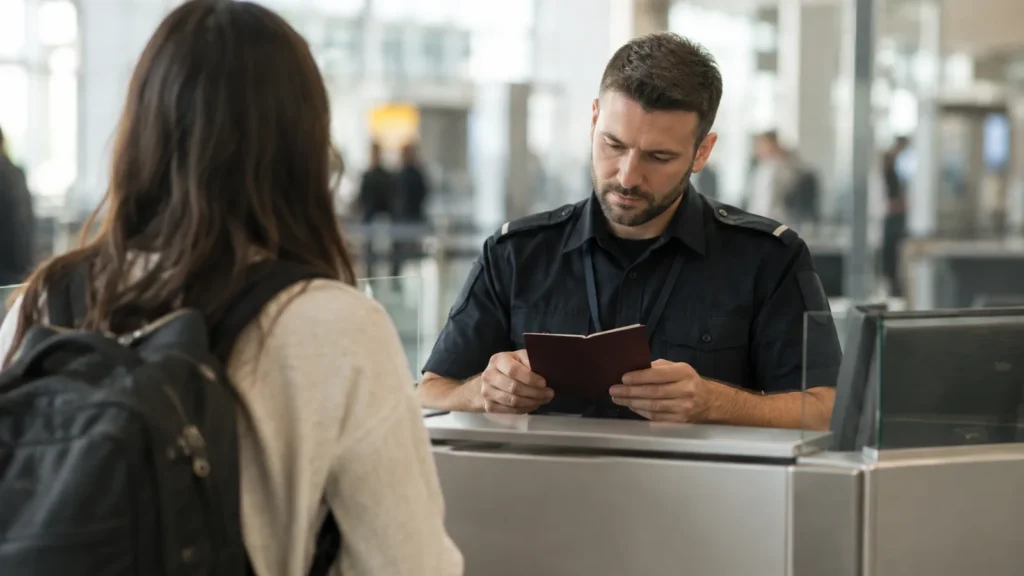
If you want to stay longer than the date on your I-94, you request an extension from USCIS on Form I-539 before that date passes. USCIS recommends filing at least 45 days ahead. Extensions come in increments of up to six months at a time.
A few things worth knowing before you file:
- the fee is $470 on paper and $420 online. The separate $85 biometrics fee is gone. It has been folded into the main fee since April 1, 2024;
- the median processing time for Form I-539, per USCIS data for the third quarter of fiscal year 2026, is 5.7 months, up nearly twofold over the last three quarters, with 133,000 applications pending as of the end of June 2026;
- check the form edition on the day you file. After a September 14, 2026 court ruling, USCIS is only accepting the 08/28/24 edition;
- switching from B-1 to B-2 does not need a separate application, as long as you are already in the US and your authorized stay has not expired.
Changing status, to a student visa for example, is also filed before your authorized stay expires, and you cannot change your behavior before it is approved. USCIS puts it plainly - do not start attending school before your change of status is approved. A change of status made inside the US does not give you a new visa either. If you leave the country, you apply for a new visa at an embassy.
This is also where the "90-day rule" comes in. If you do something inconsistent with your status within 90 days of applying for the visa or being admitted, the officer can presume willful misrepresentation. That brings lifetime inadmissibility under INA 212(a)(6)(C)(i). Two details rarely make it into other write-ups. Filing for a change of status by itself is not a violation, and the FAM says so directly. After the 90 days pass, the automatic presumption goes away, but the liability for actual misrepresentation does not.
Want to stay in the US longer, or change your status? Let's go over the risks before you file
Leave a request and we will contact you shortly
Denial under 214(b), 221(g) processing, and visa revocation
A 214(b) denial means one thing - you did not convince the officer that you will return home. There is no appeal, but the refusal applies only to that specific application. You can apply again as soon as the next day. It makes sense to do so if your circumstances have changed or you have new documents to show. A new application means a new DS-160, a new $185 fee, and a new appointment. The old fee is not refunded. There is no official six-month waiting period after a denial. That figure is a myth.
221(g) is technically a refusal too, not a "pause". There are only two outcomes for a visa application, issue or refuse. It comes in two forms. The first is a missing document. You get a letter listing what is needed, with a year to submit it and no new fee. The second is administrative processing, where the officer could not reach a conclusion about your eligibility. There is no set timeline here. The State Department says the length depends on the details of the case, and it asks applicants not to inquire about status before 180 days from the interview or the document submission. The commonly quoted figure of "60 days" for processing is not officially confirmed anywhere.
An already-issued visa can be revoked. INA 221(i) allows this at any time, at the discretion of the consular officer or the Secretary of State. There is almost no judicial appeal, and the applicant only has to be notified "if practicable". Once the revocation is entered into the system, the visa is invalid whether or not you find out about it. In August 2026, the State Department reported more than 175,000 revoked visas, most tied to law-enforcement encounters, mainly assault, drunk driving, theft, and drug offenses. Social media posts are mentioned among the grounds too, though press coverage tends to overstate how common that is.
Children, giving birth in the US, and other special cases
Children. Every child needs their own application and their own $185 fee, whatever their age. A parent or guardian fills out and signs the form for any applicant under 16. The commonly quoted age of 14 is a mix-up with the old interview exemption. Dropbox is never available to minors, because one of the conditions is being 18 or older when the previous visa was issued. Whether both parents need to attend the interview, or whether a birth certificate is required, is up to the specific embassy. There is no such rule in State Department regulations. Check the website of the consulate where you are applying.
Giving birth in the US. Since 2020, the regulation has explicitly excluded from "pleasure" any trip whose main purpose is having a baby in the US to get them citizenship. If the officer has reason to believe you will give birth during your trip, a presumption kicks in that this is your purpose. It can be rebutted, but the list of what counts is short - a complicated pregnancy, say, combined with an arrangement for specialized care that is not available where you live. Having a birth plan with a US clinic does not rebut it on its own. Officers are barred from asking every woman about pregnancy, or from demanding proof that she is not pregnant. They need a specific reason first.
Entry restrictions. Presidential Proclamation 10998, in effect since January 1, 2026, affects nationals of 39 countries, with B-1/B-2 suspended for 19 of them. It does not cancel visas already issued, and it does not apply to anyone who was in the US, or already held a valid visa, on the date it took effect. Check the official list if you are unsure whether your nationality is affected.
Visa bonds. For nationals of a small number of countries, the consular officer can require a bond of $5,000, $10,000, or $15,000 on Form I-352. Check the official list to see if your country is on it. Payment goes only through Pay.gov, and only after the consular officer tells you to pay. Anyone else offering to handle this for you is running a scam.
Frequently asked questions about the US tourist visa
What to do next
A tourist visa is not granted for a stack of paperwork. The officer is looking at how firmly your life is anchored at home. So the real work does not start with a hotel booking. It starts with an honest look at your situation from the officer's side of the desk. What you do for a living, what keeps you there, why you are traveling now, and with what money.
If anything in your history raises questions - a past refusal, long stays in the US, relatives with a green card, a recent move to another country - work through it before you apply, not after a denial. For help preparing for the interview and assessing your chances, see our B1/B2 visa service. And if the real goal is not a visit but a move, start somewhere else, with legal ways to immigrate to the US.
Need a US tourist visa without unnecessary risk? Book a consultation
Leave a request and we will contact you shortly
How to Fill Out the DS-260 - Submission, Confirmation Page, and Unlock
The DS-260 is the online form for a US immigrant visa. Every applicant who gets a green card through a US consulate - family-based, employment-based, or through the Green Card Lottery - has to file one. The form is long, only in English, and everything in it gets checked against your documents and your answers […]

How to Fill Out the DS-160 Form - Step-by-Step Guide and Common Mistakes
DS-160 is the online application for a US nonimmigrant visa. Every applicant files a separate form, including infants, whether they are applying for a tourist visa, a student visa, a work visa or a K-1 fiance visa. The State Department estimates the form takes 90 minutes to complete, and that assumes you already have all […]
How to Read the US Visa Bulletin - F1, F2A, F2B, F3 and F4 Queues
The Visa Bulletin is a monthly table from the US State Department showing whose place in line for an immigrant visa has come up. For relatives of US citizens and green card holders in the F1-F4 categories, it's the key document in the whole process - an approved I-130 petition can wait years for its […]