











How to Fill Out Form I-130 - Step-by-Step Instructions and Sample

Form I-130 (Petition for Alien Relative) is the first document in almost every family-based immigration case to the US. A citizen or green card holder uses it to establish that a foreign national is their spouse, child, parent, sibling. Below is who files it on whom, what documents to gather beforehand, how to fill out the form part by part, what it costs, what happens after you file, and how long the wait runs for each category.
What Form I-130 Is and Who Files It
I-130 is filed by the relative in the US (the petitioner) on behalf of the foreign relative (the beneficiary). The form does not grant anything by itself, no visa, no status. An approved petition means one thing - USCIS recognized the relationship and the petitioner's right to file for that person. From there, the beneficiary either gets an immigrant visa at a consulate or adjusts status inside the US.
A US citizen or a green card holder can file I-130. One petition covers one relative. If a citizen is bringing over a wife and her children, each child needs a separate I-130. The F categories work differently. The beneficiary's spouse and children travel with them on the same petition, and they are simply listed on the form.
The form is filled out in English only. There is no translated version. Documents in other languages need a certified translation into English attached. The official form and instructions are on the I-130 page at USCIS.
Need help with Form I-130? We'll review the petition before it goes to USCIS
Leave a request and we will contact you shortly
Who You Can Bring Over on I-130, and How Long the Categories Wait
The category depends on who the petitioner is and what the beneficiary is to them, and the category determines whether there is a queue at all.
| Petitioner and beneficiary | Category | Queue (September 2026) |
|---|---|---|
| Citizen filing for a spouse | IR-1 / CR-1 | none |
| Citizen filing for an unmarried child under 21 | IR-2 | none |
| Citizen 21+ filing for a parent | IR-5 | none |
| Citizen filing for an unmarried child 21+ | F1 | petitions filed by January 22, 2020 |
| Green card holder filing for a spouse or child under 21 | F2A | petitions filed by August 22, 2026 |
| Green card holder filing for an unmarried child 21+ | F2B | petitions filed by August 22, 2019 |
| Citizen filing for a married child | F3 | petitions filed by October 22, 2014 |
| Citizen 21+ filing for a sibling | F4 | petitions filed by October 22, 2011 |
Immediate relatives of citizens (the top three rows) have no annual quota. The only wait is for USCIS to process the paperwork. F categories move by the Visa Bulletin, and the date in the table is the Final Action Date for most countries as of September 2026. The bulletin updates every month, and the dates move, sometimes backward.
A green card holder cannot file I-130 for parents or siblings. If they become a citizen, an already-filed petition for a spouse or a child under 21 automatically upgrades to the immediate relative category with no queue, and a petition for an unmarried son or daughter 21+ becomes F1 with the same priority date. Report the naturalization to USCIS or the NVC.
More detail on the spouse visa is in our article on CR-1 and IR-1, and on other family categories in our pages on the IR visa and the F1, F2A, F2B, F3, F4 categories. If the wedding has not happened yet, I-130 does not apply. You need Form I-129F for the K-1 fiance visa instead.
What to Prepare Before You Fill Out the Form - Documents and Form I-130A
Gather the package before you sit down to fill in the form. Half of the answers come straight from these documents.
- Petitioner's status. For a citizen - a copy of a US passport, US birth certificate, naturalization certificate or certificate of citizenship. For a green card holder - a copy of the card, both sides.
- The relationship. Marriage certificate, birth certificates. For a father, add the marriage certificate to the child's mother. For siblings, birth certificates for both showing a shared parent.
- Past marriages. Divorce or death records for any prior spouses, on both sides.
- Name changes. If your name appears differently across documents, attach the record that explains it (marriage certificate, court order).
- A genuine marriage, for a spouse petition. Shared housing or a lease, joint accounts, birth certificates of children you have together, photos, written statements from people who know you.
- Photos, for a spouse petition. Two identical color photos, 2x2 inches, of the petitioner and the spouse, taken no earlier than 30 days before filing.
- Translations. Every document not in English needs a full translation plus the translator's certificate of accuracy.

Send copies. USCIS may destroy original documents sent without a request. If an official record does not exist, for example a birth certificate, you need a statement from the registering authority confirming that, plus secondary evidence.
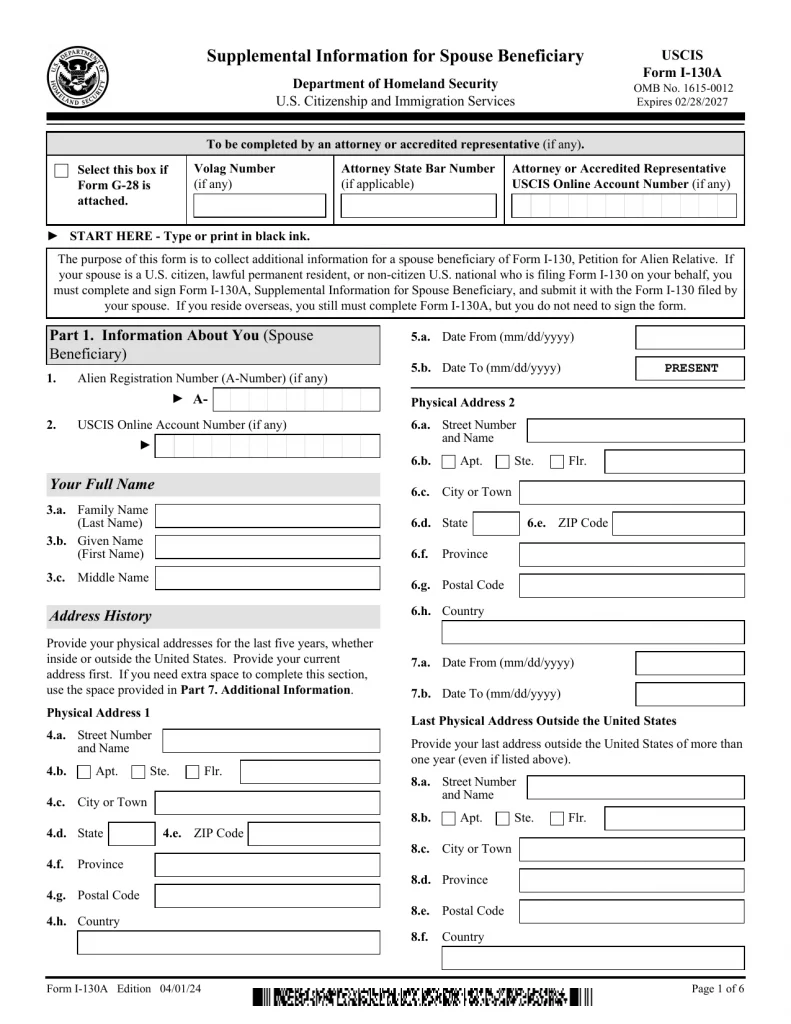
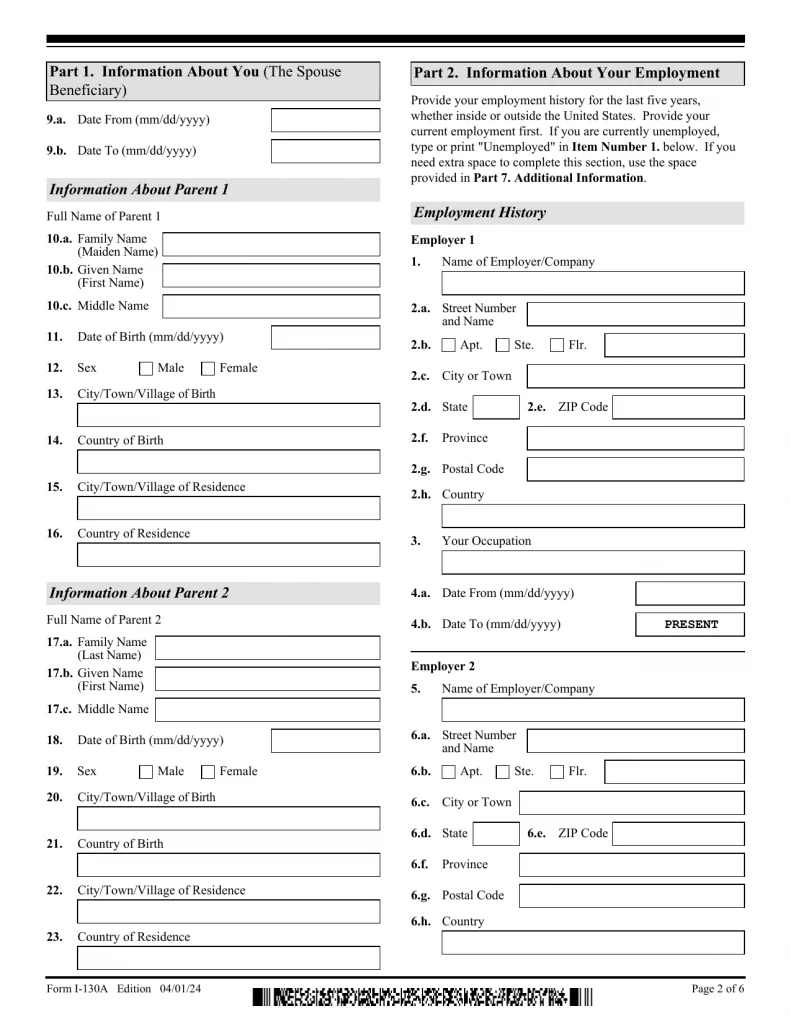
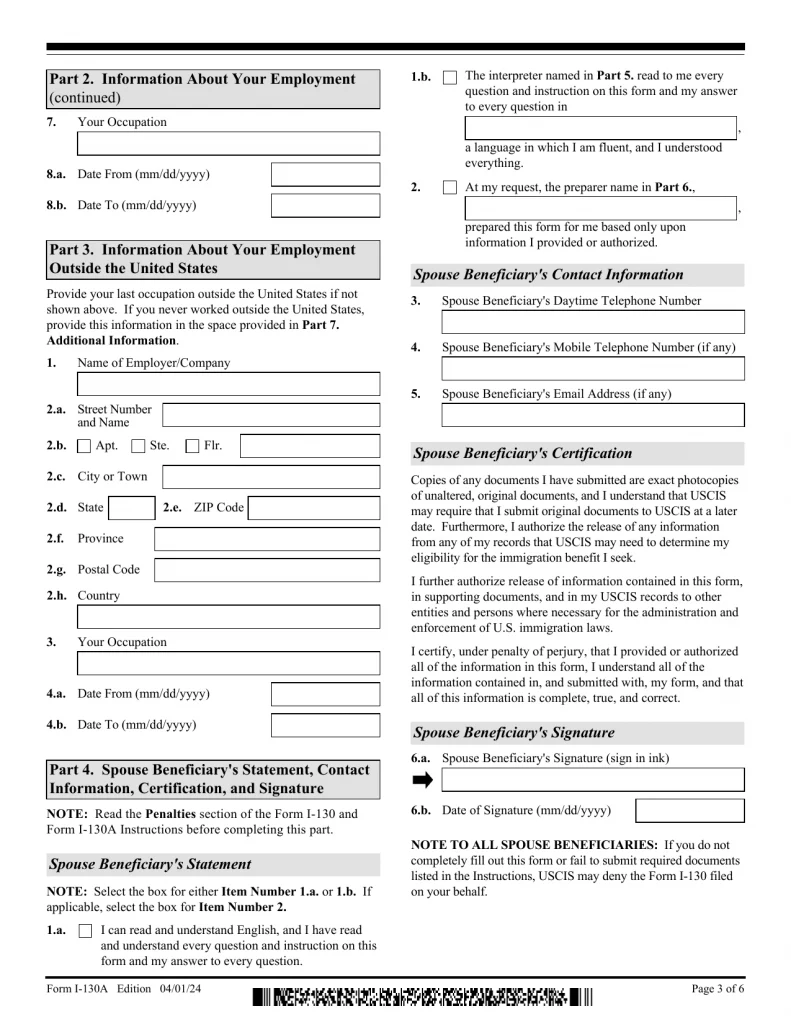
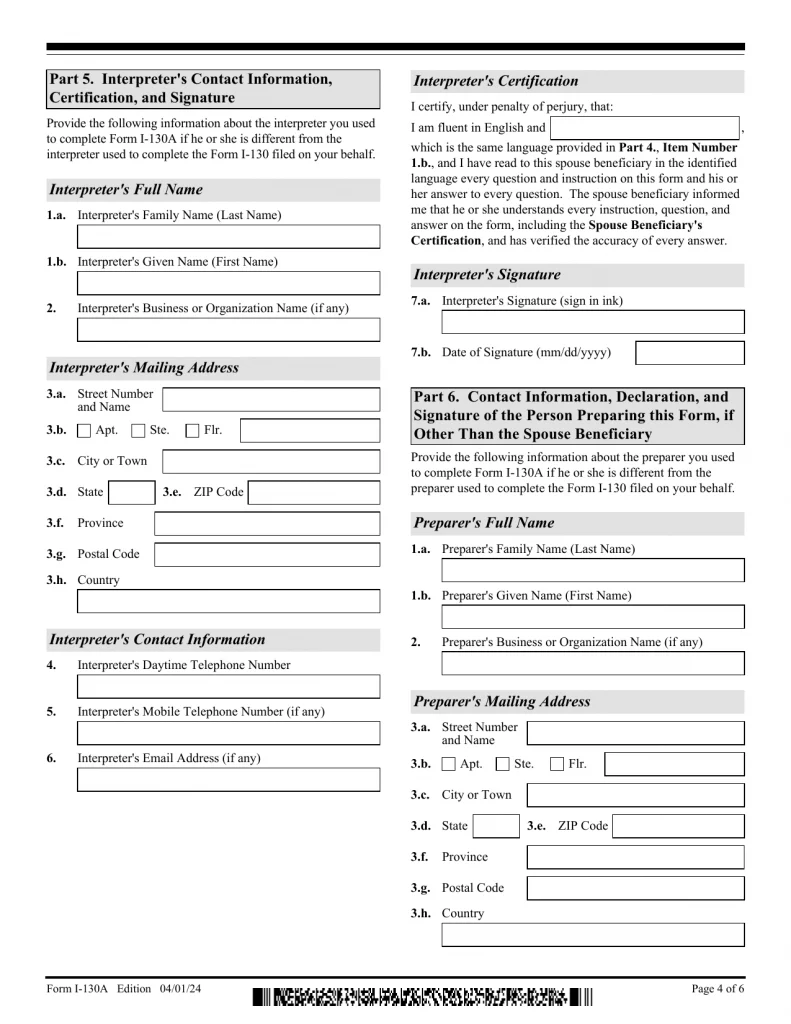
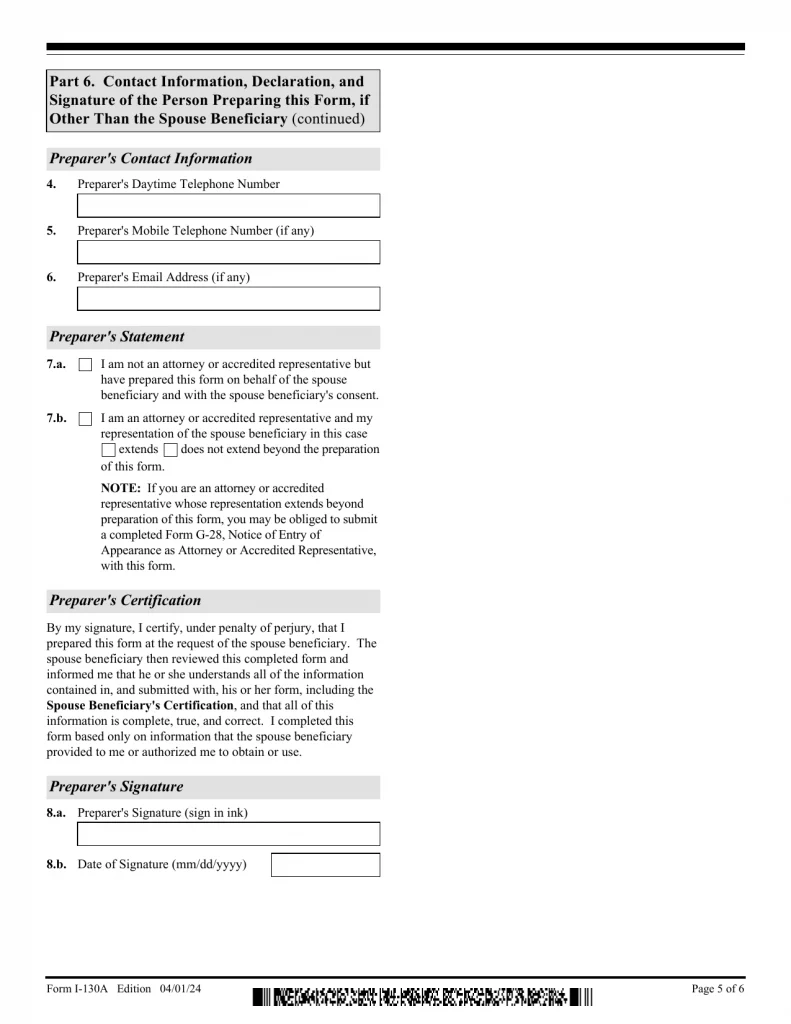
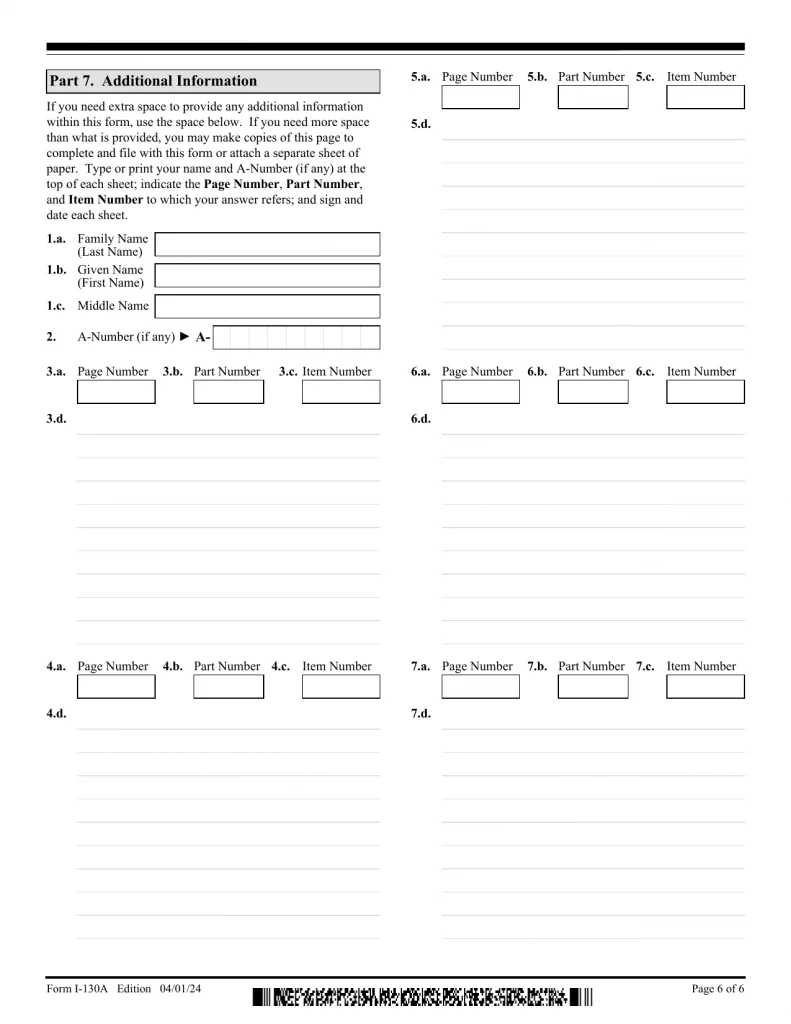
If the petition is for a spouse, Form I-130A goes in with I-130, the beneficiary spouse's questionnaire. It covers 5 years of addresses, the last address abroad if you lived there over a year, parents, 5 years of employment. It is never filed on its own. There is no separate fee, and a spouse living outside the US does not have to sign it.
How to Fill Out Form I-130 Part by Part
The current edition of I-130 and I-130A is dated April 1, 2024 (04/01/24 on the form). USCIS does not accept any other edition, and every page has to come from the same edition. Download the form only from uscis.gov. Three rules cover the whole form. For a question that does not apply to you, write N/A. If the answer is zero, write None. Dates go mm/dd/yyyy. Height in feet and inches, weight in pounds.
Part 1. Relationship - what the relative is to you
Check one box - spouse, parent, sibling, child. For a child or a parent, you also specify the kind of relationship, born in or out of wedlock, stepparent, adoption.
Part 2. Information About You - the petitioner's data
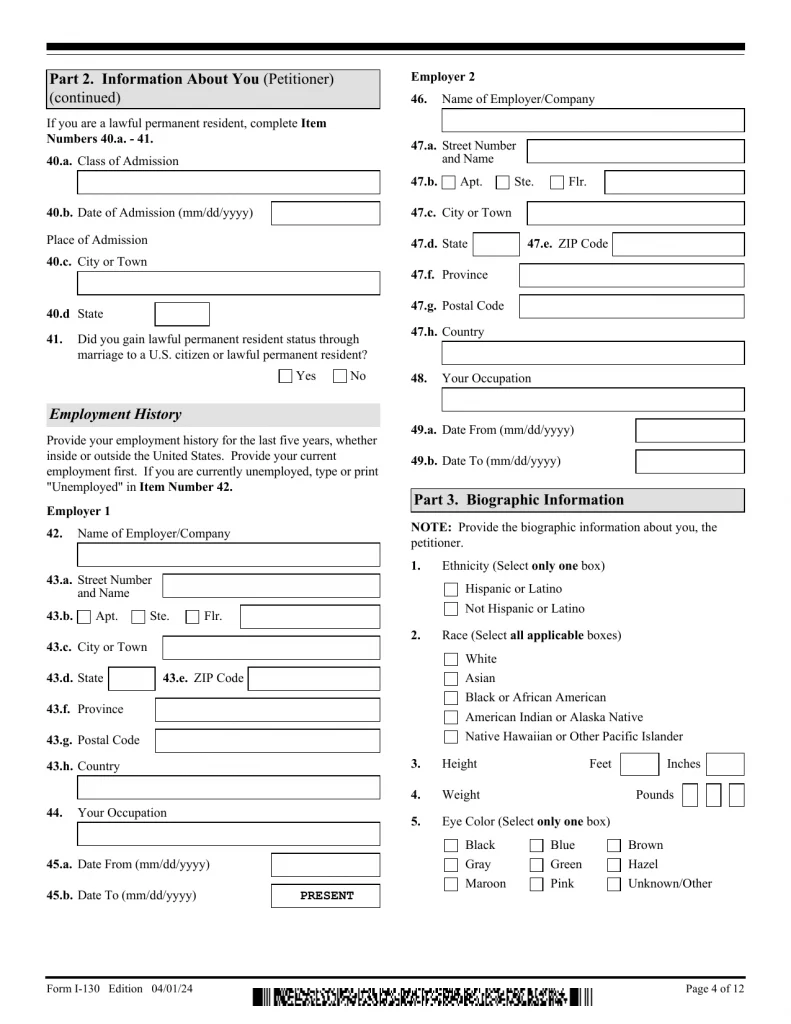
A-Number, USCIS online account number (only applies if your case number ever started with IOE), SSN. Every name you have ever used, including a maiden name. Mailing address and every physical address for the last 5 years, current one first. Every marriage with its end date. Parents. How you got your citizenship or green card. 5 years of employment, write Unemployed if that applies.
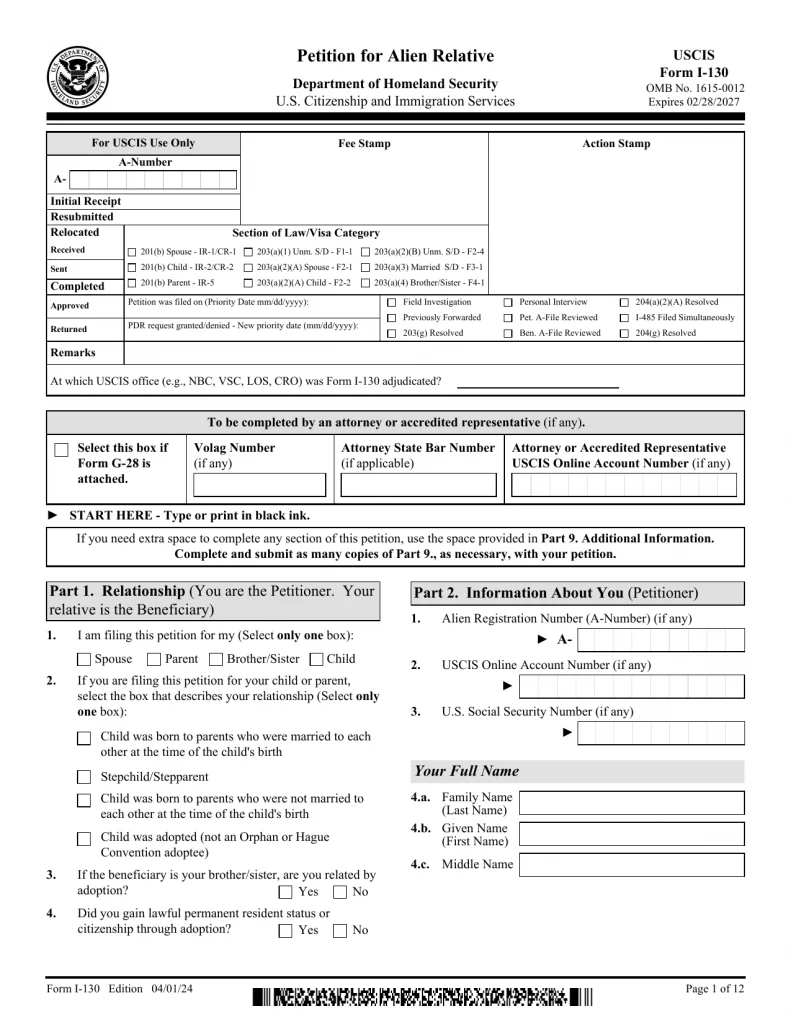
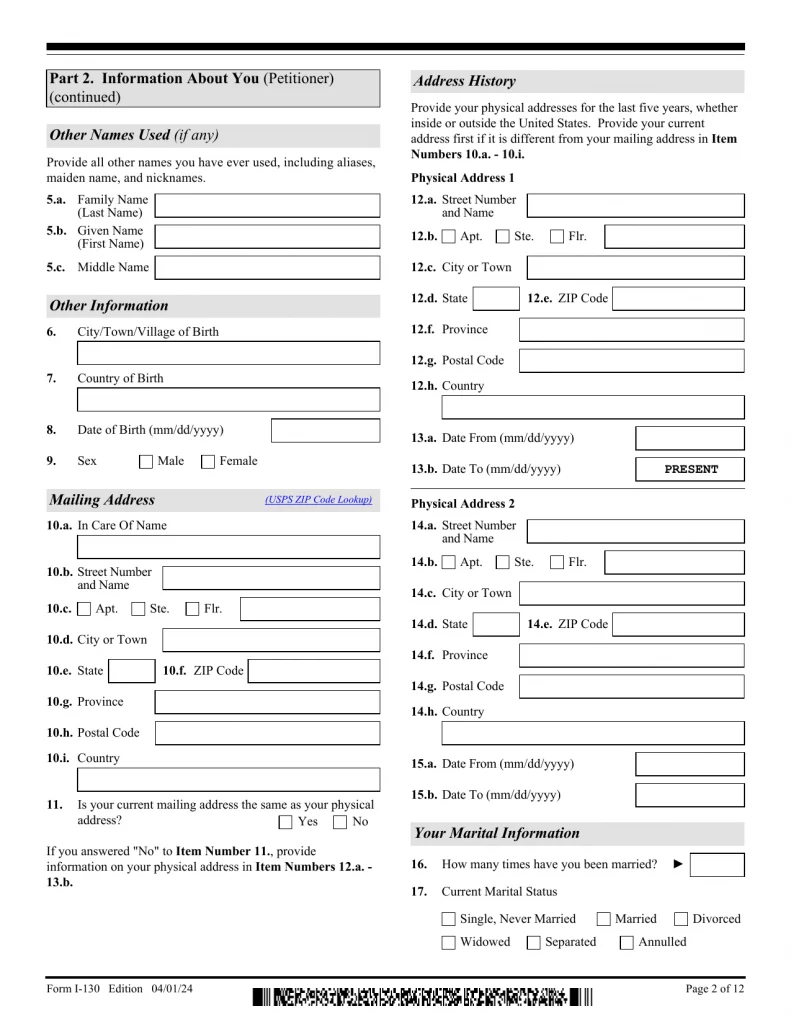
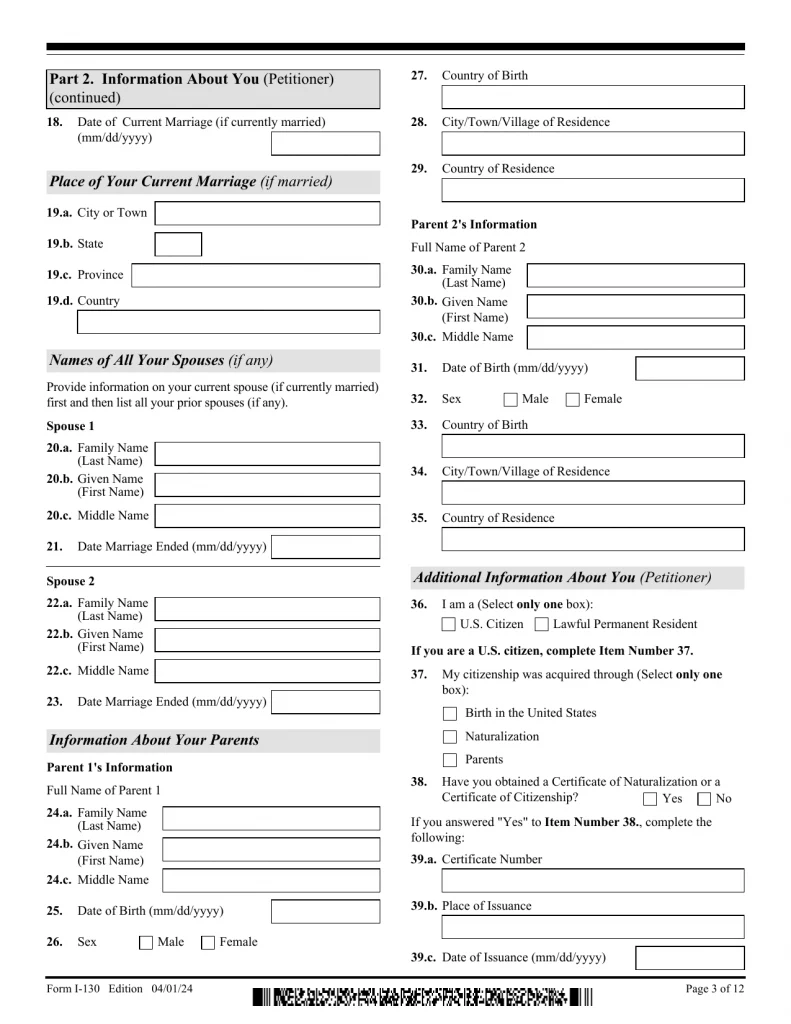
Part 3. Biographic Information - petitioner's physical description
Ethnicity, race, height, weight, eye and hair color.
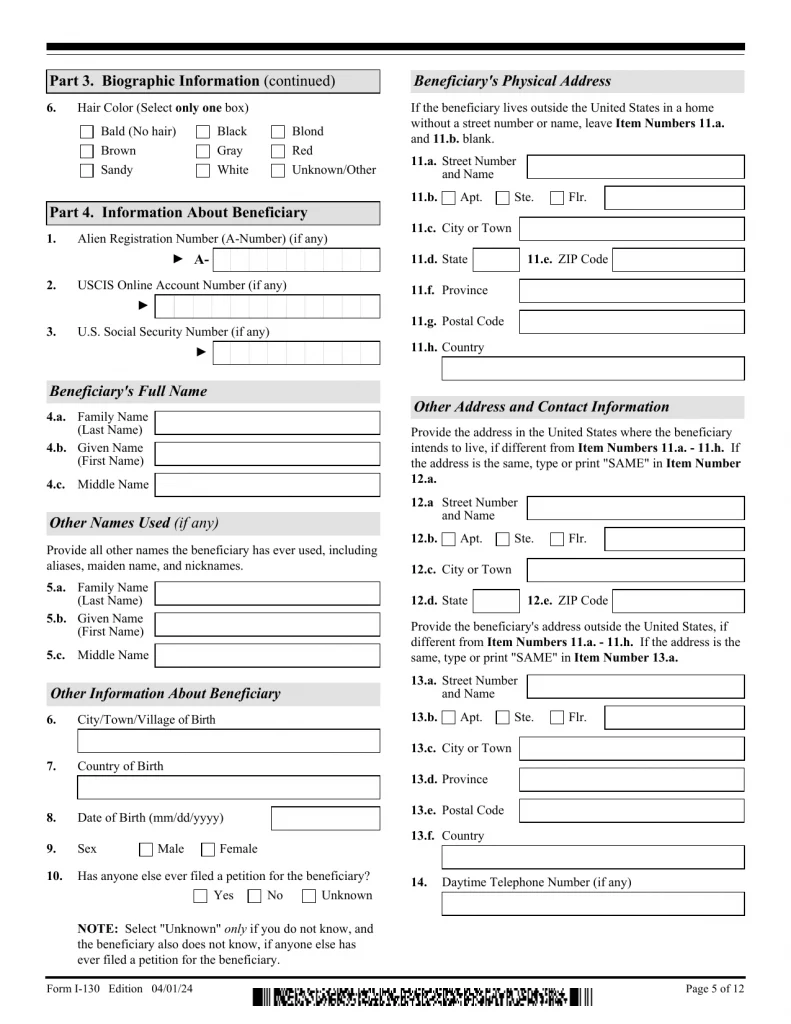
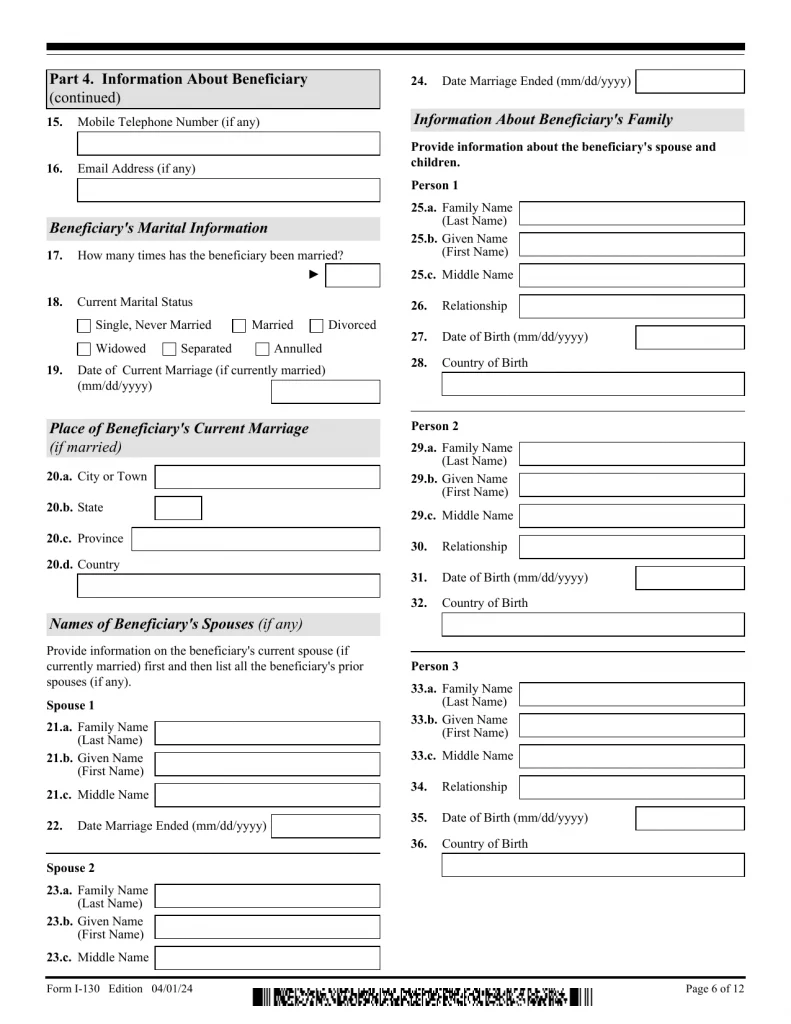
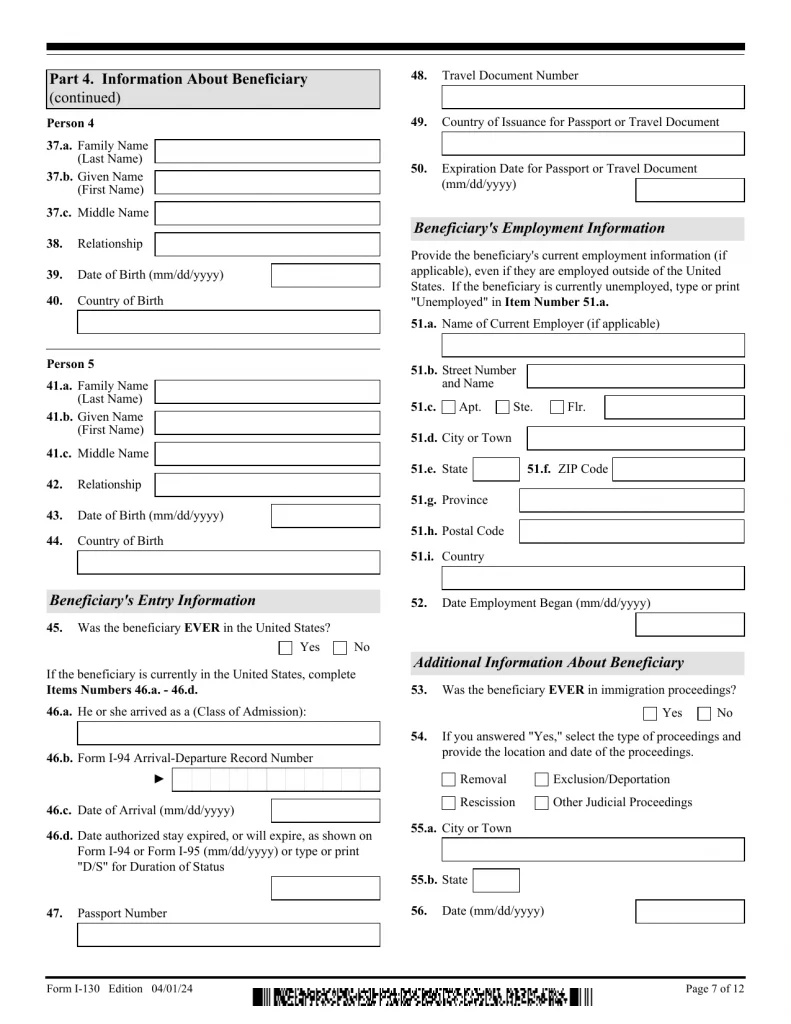
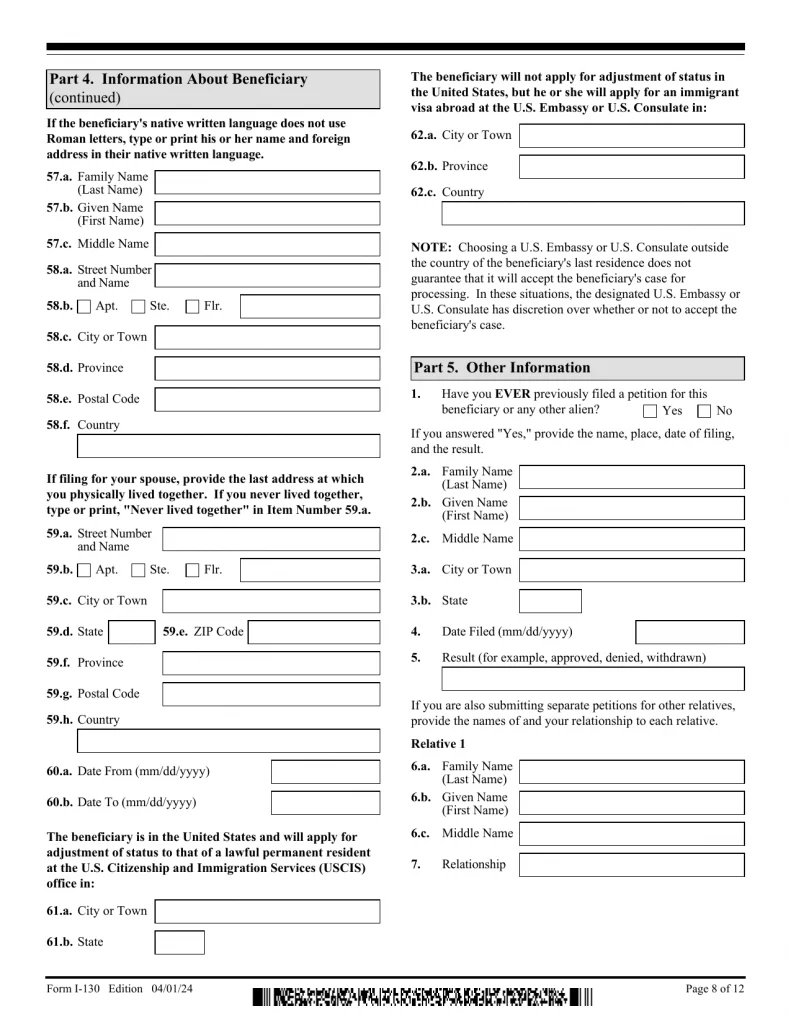
Part 4. Information About Beneficiary - the relative's data
The longest part. Names, birth details, numbers, whether anyone has filed a petition for them before (Unknown is acceptable only if neither of you knows). Address, marriages, spouse and children. Entries into the US, I-94 number and passport, even an expired one. Employment, other immigration proceedings. Items 57-58 ask for a name and address in the native alphabet, the only place in the form where non-Latin script is allowed.
Items 61 and 62 matter most. Item 61 names the USCIS office if the relative is in the US and will adjust status. Item 62 names the consulate if they will get a visa abroad. Check exactly one. Check both or neither, and USCIS decides based on the beneficiary's address instead.
Part 5. Other Information - past and parallel petitions
Whether you have filed petitions before, for this or another foreign national, and how they turned out. Which relatives you are petitioning for right now.
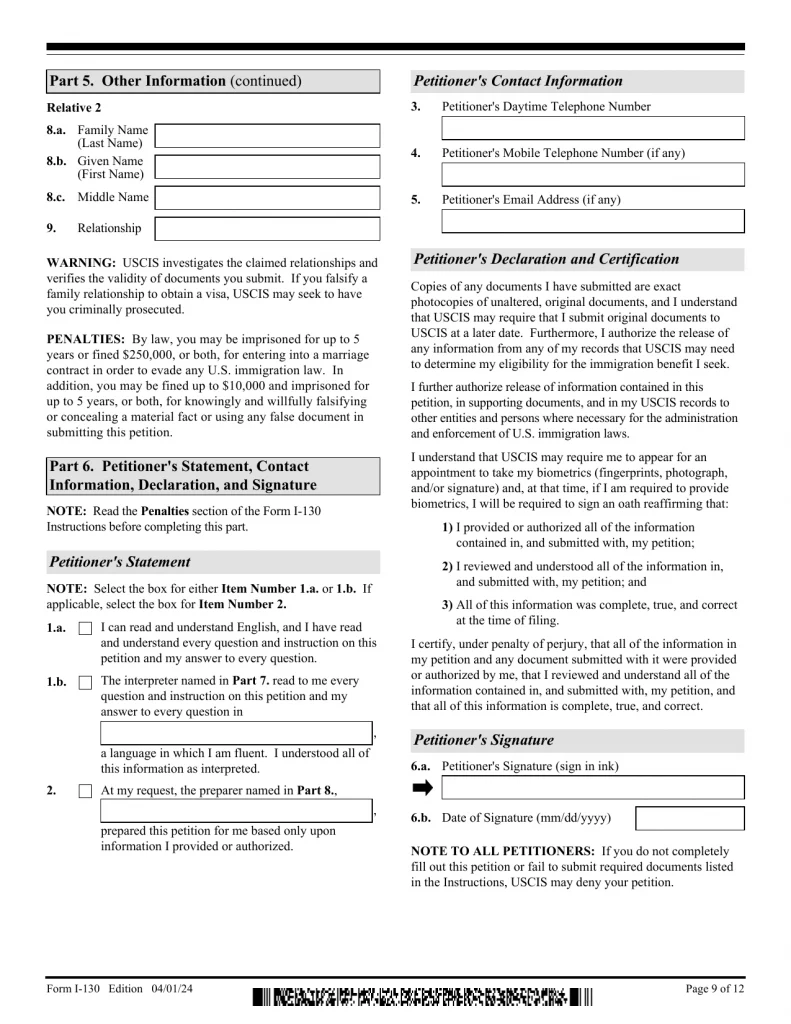
Part 6. Petitioner's Statement, Contact Information, Declaration, and Signature
Whether you read English or needed an interpreter, whether someone else prepared the form, phone, email, signature and date. A signature has to be handwritten or done through the online account. A typed or stamped name gets the form rejected.
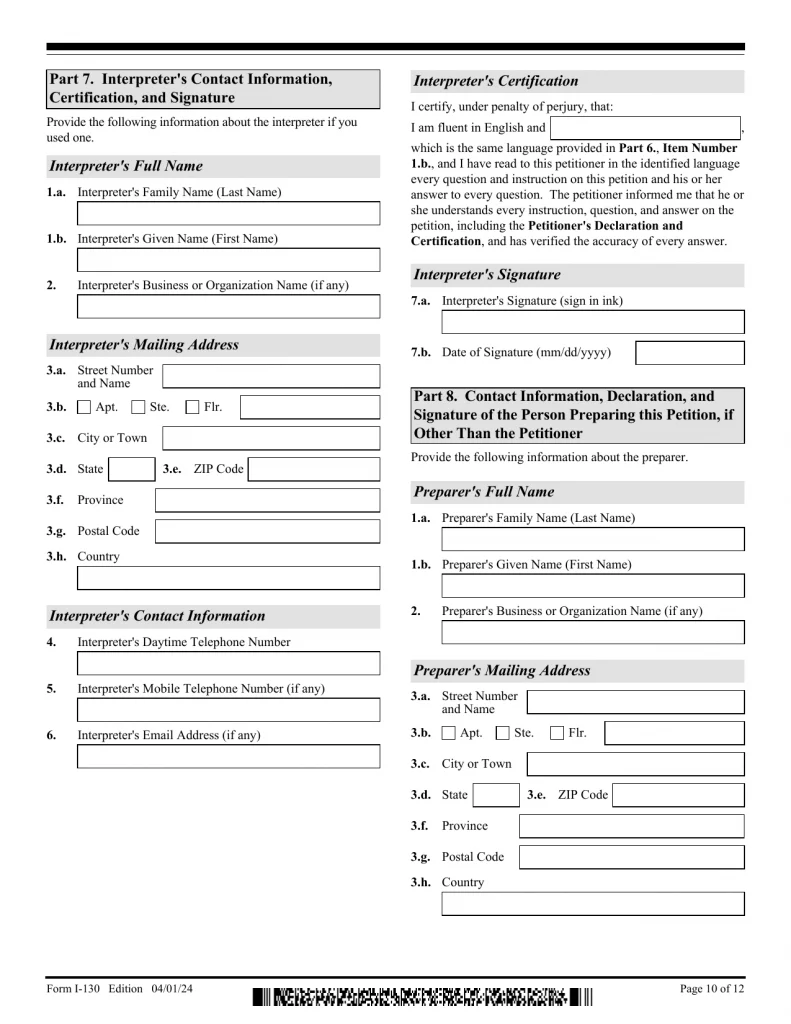
Part 7 and Part 8. Interpreter and Preparer
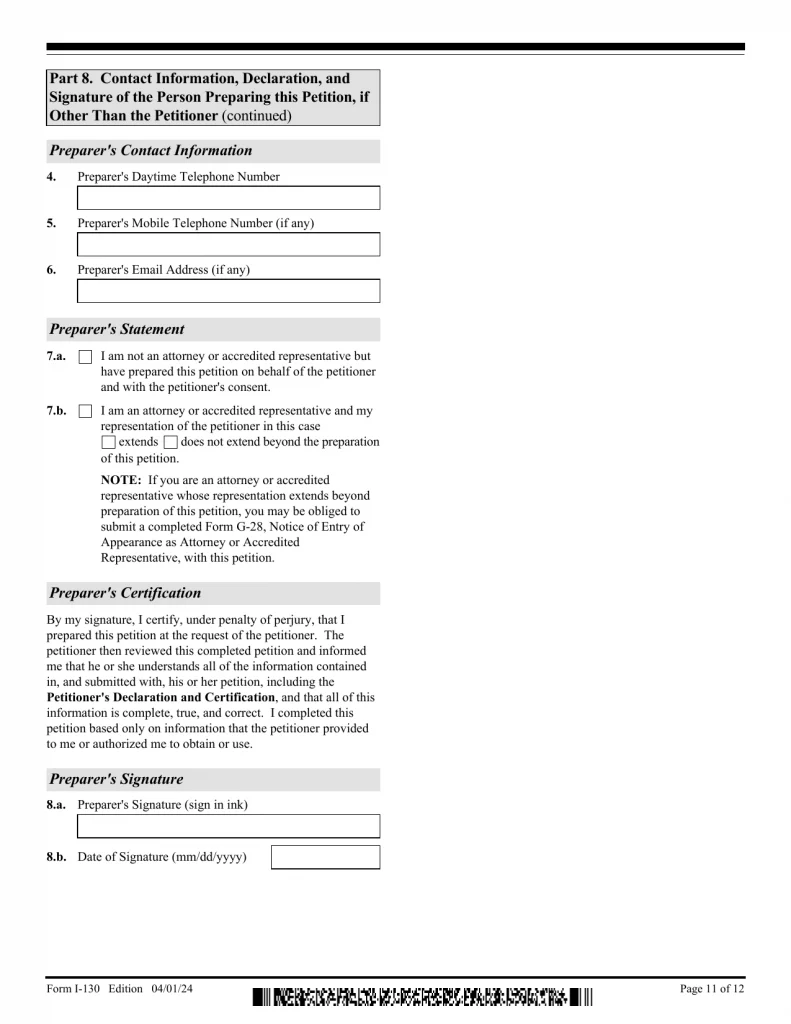
Fill these in if an interpreter translated the form or someone else prepared it, with their information and signature. For an attorney with full representation, attach Form G-28.
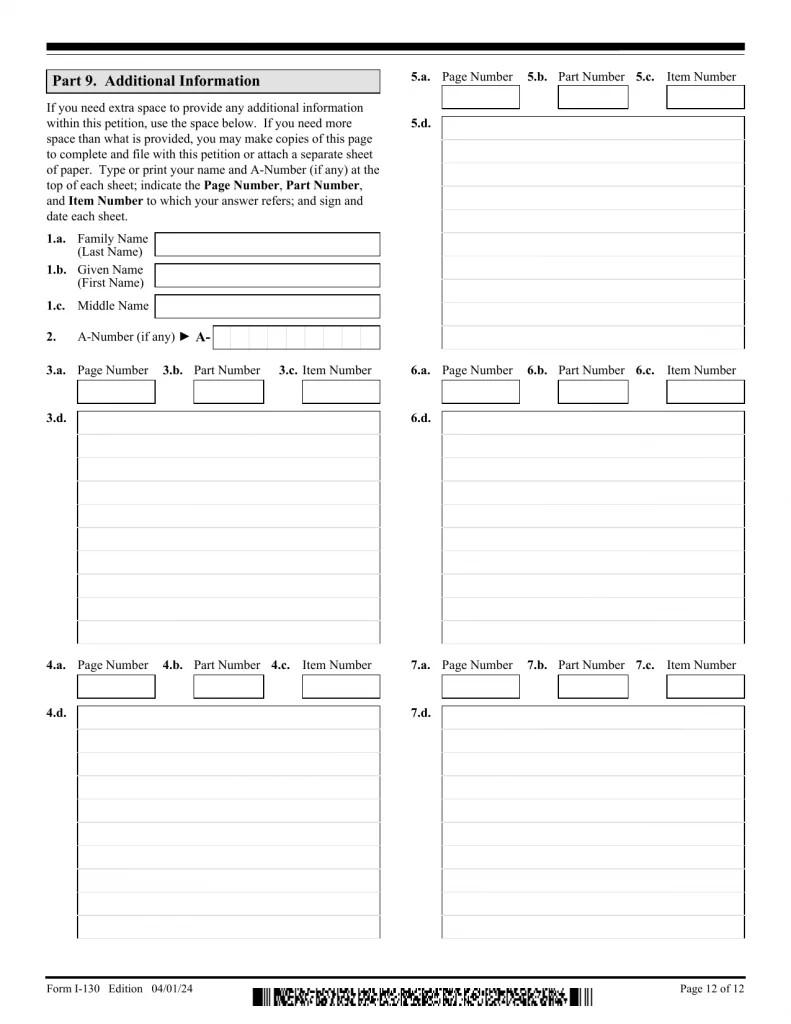
Part 9. Additional Information - overflow space
Answers that did not fit go here. Every extra page needs your name, A-Number, page number, part and item number, and a signature.
Common Mistakes When Filling It Out
Almost every one of these is spelled out in the USCIS instructions, and they are exactly why forms get rejected or delayed.
- Blank fields. Skip N/A or None and the form can get returned. Skip Part 1, a full name, date of birth or address for the petitioner or beneficiary, and it gets rejected outright.
- Pages from different editions, or an old edition downloaded from somewhere other than USCIS.
- Both items 61 and 62 checked, or neither one.
- Incomplete 5-year address and employment history, gaps left unexplained, a maiden name left out.
- Past marriages not disclosed, or missing the documents that closed them out.
- A US citizen's stepchildren listed on the same petition. They each need their own I-130.
- Centimeters and kilograms instead of feet and pounds, dates in a non-US format.
- Documents without a translation, or a translation missing the translator's certificate.
- Originals sent instead of copies.
One more thing about an incomplete package. Starting August 5, 2026, USCIS can deny a petition outright, with no request for evidence, if a required document is missing. Counting on USCIS to "ask for whatever's missing" no longer works.
Unsure how to answer something on Form I-130? Let's go over the tricky fields with a lawyer
Leave a request and we will contact you shortly
How to File I-130 - Online or by Mail, and What It Costs
You can file two ways - online through a USCIS account (a step-by-step questionnaire or uploading a completed PDF), or by mail to a lockbox. The address depends on your state and on whether you are filing I-130 together with I-485. Check the current one on the USCIS filing addresses page. A petitioner living abroad mails the form to Elgin or files online. Filing through a US embassy is only available to a citizen petitioning for an immediate relative, and only in exceptional circumstances.
| Filing method | Fee |
|---|---|
| By mail | $675 |
| Online | $625 |
| Form I-130A | no separate fee |

Paying by mail only works by card (Form G-1450) or a direct debit from your account (G-1650). Checks are no longer accepted. Fees follow the USCIS fee schedule as of September 2026.
Online filing is not mandatory yet. But starting August 2026 USCIS can make it mandatory for specific forms with 60 days' notice, so check the form's page before you file. Filing I-130 and I-485 online as one package is only available to an attorney or an accredited representative. Without one, the petitioner files I-130 from their own account, and the beneficiary files I-485 from theirs, only after the receipt notice comes in.
What Happens After Filing - Receipt Notice, Status, Requests
You first get a receipt notice, Form I-797C, with a 13-character case number, three letters and ten digits. Check status with that number in Case Status Online or your USCIS account. The date USCIS received a correctly filled out and paid petition becomes your priority date. A rejected form does not get one.
USCIS may then call you in for biometrics or an interview. A marriage-based case gets an interview if there is not enough evidence the marriage is real, or if the documents show contradictions or signs of fraud. Missing your biometrics appointment can end in a denial.
How long a decision takes. The USCIS Case Processing Times tool shows current estimates. By official USCIS statistics for April-June 2026, the median processing time for I-130 filed for immediate relatives of citizens was 13 months, and for every other category it was 43.3 months, with over 2.4 million petitions pending. These are averages, not a promise for your case. In F categories, the Visa Bulletin queue gets added on top of that wait.
The petition alone gives you no status. If the beneficiary is in the US without legal status, a filed or even approved I-130 does not protect them from removal.
After Approval - NVC and the Consulate, or Adjustment of Status in the US
Approval arrives on Form I-797. Where the case goes next depends on your answer in items 61-62.
- Relative abroad. The petition moves to the National Visa Center (NVC). There you pay $325 for the immigrant visa application and $120 for the I-864 affidavit of support review, fill out the DS-260 form and upload documents, then attend a consulate interview. After the visa is issued, add the $235 USCIS Immigrant Fee. If the DS-260 gets locked after submission, our guide to unlocking it can help.
- Relative in the US who can adjust status. They file Form I-485 for adjustment of status, if it was not filed together with I-130. Since May 2026, USCIS treats adjustment of status explicitly as a discretionary decision, so for anyone who entered on a temporary visa, it is not a formality anymore.
In F categories, the next step only opens once the priority date comes up on the Visa Bulletin. An approved petition does not expire on its own, as long as the relationship and the petitioner's status hold. But if the relative does not apply within a year after the NVC notifies them that a visa is available, the registration can be terminated.
Financial requirements get checked at the next step, on Form I-864, and starting September 18, 2026, also under the new public charge rule. From January to August 2026, the State Department paused issuing immigrant visas to nationals of 75 countries. A court vacated the pause on August 21, but the case is still going through appeal, so check the State Department page before your interview.
Frequently asked questions about Form I-130
I-130 gets won on accuracy. Before you send the petition, check every name, date and address against your documents, confirm no field is blank, and keep a copy of the entire package. You will need those same answers again at the NVC and at the interview. If your family history includes past marriages, denials or status complications, work through them before filing. More detail on the full path is on our family-based immigration page.
Petition approved or stuck? We'll tell you the next step for your case
Leave a request and we will contact you shortly

How to Fill Out the DS-260 - Submission, Confirmation Page, and Unlock
The DS-260 is the online form for a US immigrant visa. Every applicant who gets a green card through a US consulate - family-based, employment-based, or through the Green Card Lottery - has to file one. The form is long, only in English, and everything in it gets checked against your documents and your answers […]

How to Fill Out the DS-160 Form - Step-by-Step Guide and Common Mistakes
DS-160 is the online application for a US nonimmigrant visa. Every applicant files a separate form, including infants, whether they are applying for a tourist visa, a student visa, a work visa or a K-1 fiance visa. The State Department estimates the form takes 90 minutes to complete, and that assumes you already have all […]

How to Get an L-1 Visa in the US and an L-2 Visa for Your Family