











What is required to obtain a U.S. Green Card through the EB-5 program


What is the EB-5 immigrant investor program and what status it provides
The EB-5 immigrant investor program – is a federal initiative of the United States created to attract capital into the country’s economy through investments from foreign nationals. In essence, the EB-5 program allows an investor to invest funds in a U.S. business and obtain a lawful immigration status. This refers to the EB-5 immigrant visa category in the United States, which opens the path to obtaining a conditional green card valid for two years. A detailed description of the visa classification is available on the official USCIS page. If the applicant meets the requirements – primarily related to job creation – they gain the right to obtain permanent status and later apply for a permanent green card and even U.S. citizenship. Current requirements and the official description of the program are published on the USCIS website.
The key difference of EB-5 compared to other categories is that it is specifically an EB-5 visa for immigrant investors, not a work or family-based program. The investor is not required to have a U.S. employer or relatives who are citizens. The basis is investment in a business and compliance with the program criteria.
Thus, the EB-5 visa in the United States provides the right to live in the country legally, work without restrictions and conduct business activities. After completing all stages of the EB-5 visa process, the investor and their family receive full immigration status with the prospect of naturalization.
Who the EB-5 visa is suitable for – basic criteria and typical applicant profiles
The EB-5 visa in the United States is suitable for foreign citizens who are ready to invest funds into the country’s economy and comply with legal requirements. The main criterion – participation in the EB-5 investment program, which involves investing capital in a commercial enterprise in the United States with the obligation to create at least 10 jobs. These must be full-time jobs in the United States, which is a key condition for EB-5 project approval.
Most often, EB-5 visa applicants – are entrepreneurs, business owners or investors interested in long-term residence and business development in the United States. The program is also suitable for those who consider the EB-5 immigrant visa in the United States as a strategic step for relocating the entire family and obtaining a stable legal status.
A separate category – investors who choose investments through EB-5 regional centers. This format simplifies the process of confirming job creation and reduces the operational burden on the investor. As a result, the investor receives a green card, and their family obtains the right to stay and live in the United States legally with the prospect of applying for permanent residence.
EB-5 options – direct investment and projects through a regional center
Within the EB-5 program, an investor can choose one of two participation formats – direct investment or investment through EB-5 regional centers. Both options allow obtaining the EB-5 immigrant visa in the United States, however they differ in business management structure and in the method of confirming job creation.
With direct investment, the applicant invests funds in their own or a partner commercial enterprise in the United States and is personally responsible for operational activities. In this case, the investor must ensure the creation of 10 full-time jobs in the United States. This path is more often chosen by entrepreneurs who plan to actively participate in managing and developing a business in the United States.
An alternative is investment through EB-5 regional centers, where the project is already structured and managed by a professional team. Within the EB-5 investment program, a regional center may count both direct and indirect jobs, which simplifies meeting the program requirements. For many investors, this format is more predictable in terms of timelines and the EB-5 visa process, especially if the goal is not operational activity but obtaining status and relocating to the United States. An updated list of approved regional centers and explanations of their status are published on the official USCIS page dedicated to EB-5 regional centers.
Main EB-5 visa requirements in general – investment, jobs and lawful source of funds

The EB-5 visa in the United States is based on three fundamental criteria: the amount of investment, job creation and confirmation of the lawful source of capital. Within the EB-5 investment program, an investor must invest the amount established by law – most often this is 800,000 US dollars if the project is implemented in a TEA area or through EB-5 regional centers. An alternative may be a higher investment threshold outside priority areas.
The second mandatory condition – creation of at least 10 full-time jobs in the United States. This criterion forms the basis for evaluating compliance with the program requirements. Regardless of the participation format – direct investment or a project through a regional center – the applicant must prove that their investment in the business will lead to a real economic effect.
The third key element – lawful source of funds. The EB-5 immigrant visa in the United States is not approved without full financial disclosure. Therefore, confirming the origin of capital becomes one of the most complex and carefully reviewed parts of the EB-5 visa process.
What is usually meant by confirmation of the source of funds – source of funds
Confirmation of the source of funds, or source of funds, means documentary evidence that the investment was obtained legally. In the context of the EB-5 immigrant visa in the United States, the investor must show the entire financial chain – from the original source of income to the transfer of funds into the project.
This may include profits from business in the United States or abroad, sale of real estate, dividends, inheritance, gifts or other lawful income. What matters is not only the presence of funds but also transparency of the financial movement. An EB-5 investor in the United States must demonstrate that the capital is not connected to shadow activities, loans of questionable origin or undisclosed sources.
USCIS pays special attention to details because the EB-5 program is directly connected with the U.S. economy. Therefore, the review of an investor’s financial history is carried out very carefully.
What documents are often requested for the financial part and source of capital
When filing a petition within the EB-5 program, immigration authorities usually request tax returns for several years, bank statements, asset purchase and sale agreements, company incorporation documents, audit reports and proof of fund transfers. If the capital was obtained through the sale of a business, financial statements and documents confirming ownership structure may also be required.
In cases of gifts or inheritance, additional documents such as gift agreements, wills and confirmation of the source of funds from the original owner are provided. This means that not only the current investor is reviewed but also the previous source of capital.
Thus, the financial part of the EB-5 visa process requires systematic preparation and transparent documentation. The more structured the package of evidence, the higher the probability of approval and subsequent receipt of a conditional green card with the prospect of obtaining permanent status.
Need a consultation on the EB-5 immigrant investor program?
Leave a request and we will contact you shortly

Step-by-step process of obtaining a green card through the EB-5 investor visa
The process of obtaining status through the EB-5 visa in the United States is structured in stages and requires strict compliance with procedures. First, the investor chooses the format of participation in the EB-5 program – direct investment or a project through a regional center, then makes the investment and prepares a package of documents. After that, a petition is filed with USCIS, where the lawful source of funds and compliance with program requirements are reviewed. More details can be found at USCIS – EB-5 Immigrant Investor Process.
If the petition is approved, the immigration stage begins – obtaining conditional permanent resident status. As a result, the investor and their family receive the right to live and work in the United States based on a conditional green card valid for two years. The final stage – confirmation that the requirements have been met and submission of a petition to remove conditions, which allows the investor to receive a conditional green card. Only after this step is a full permanent green card issued.
Thus, the EB-5 immigrant visa in the United States – is not a one-time decision but a sequential legal process that usually takes several years.
Filing the investor petition – forms I-526 or I-526E
The first official step within the EB-5 investment program – filing the investor petition. Depending on the project structure, Form I-526 (for direct investments) or Form I-526E (for projects through EB-5 regional centers regulated by the U.S. Citizenship and Immigration Services) is used.
At this stage USCIS analyzes the source of funds, the project structure, the business plan and job creation calculations. In practice, the review of I-526 or I-526E determines whether the applicant meets the requirements for obtaining the EB-5 immigrant visa in the United States.
Approval of the petition does not mean automatic receipt of status but opens the path to the next stage – obtaining a conditional green card.
Immigration stage after approval – I-485 in the United States or DS-260 outside the United States
After the petition is approved, the investor proceeds to the immigration stage. If the applicant is already in the United States with lawful status, Form I-485 is filed to adjust status to permanent resident. If the investor resides outside the country, the procedure takes place through a U.S. consulate with the submission of Form DS-260.
This stage completes the EB-5 visa process for immigrant investors in practical terms. After approval of the application, the investor and their family members receive conditional permanent resident status.
It is important to understand that this stage represents the final transition from applicant status to holder of a conditional green card.
Conditional green card and removal of conditions – Form I-829
Initially, the investor receives conditional status valid for two years. Within 90 days before the end of this period, Form I-829 – a petition to remove conditions – must be filed. It is important for the investor to monitor the expiration date of the conditional green card in advance, since late submission of Form I-829 may create the risk of losing immigration status.
Within the EB-5 program, this stage verifies whether the investment has actually been made and whether the required number of jobs has been created. If the requirements are met, USCIS removes the conditions and the investor receives a full permanent green card without restrictions.
Completion of the I-829 stage finalizes the result of participation in the EB-5 program and opens the next perspective – the possibility to apply for U.S. citizenship in the future if residence requirements and other legal criteria are met.
EB-5 forms and applications – what is filed and at which stage
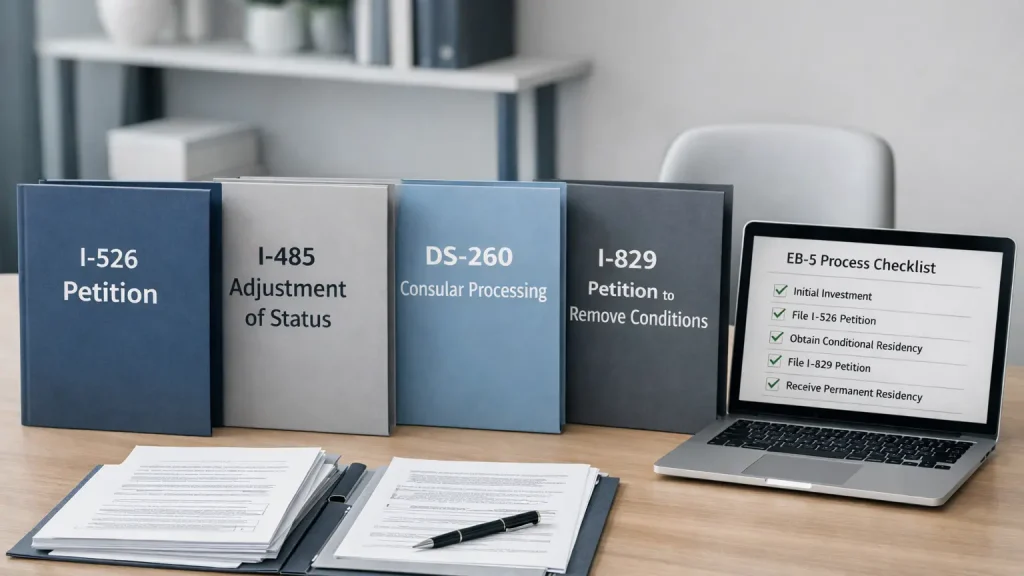
Within the EB-5 program, the application process is structured in stages, and different immigration forms are used at each stage. Understanding which documents are filed and at what moment is critical for successfully completing the EB-5 immigrant visa process in the United States.
At the first stage, the investor files petition I-526 or I-526E – depending on whether the investment is direct or participation is through an EB-5 project. This form confirms compliance with the requirements of the EB-5 investment program, including the amount of investment, the business plan and evidence of the lawful source of funds.
After the petition is approved, the immigration stage begins. If the applicant is in the United States, Form I-485 is filed to adjust status. If the investor lives outside the country, Form DS-260 is used for consular processing. At this stage, the transition to conditional permanent resident status under the EB-5 visa in the United States is formally processed, allowing the investor to obtain a conditional green card.
The final document – Form I-829. It is filed after two years of conditional residence and serves as the basis for removing conditions. Only after approval of I-829 does the investor receive a full permanent green card without conditions.
Thus, each form in the structure of the EB-5 program corresponds to a specific phase of the process – from confirmation of investment to the final approval of immigration status.
Need a consultation on the EB-5 immigrant investor program?
Leave a request and we will contact you shortly
Processing times, visa quota waiting and category limits – what affects the duration of the process
Processing times within the EB-5 program depend not only on the quality of the prepared documents but also on visa limits established by U.S. law. Each year a limited number of visas is allocated for the EB-5 immigrant visa category in the United States, and within this category there are country-based quotas. If the number of applicants from a particular country exceeds the established limit, a waiting line is formed, which directly affects the length of the process. The current status of visa quotas is published in the monthly Visa Bulletin of the U.S. Department of State.
In addition to visa quotas, the timeline is influenced by USCIS workload, the accuracy of the petition submission and the absence of requests for additional evidence. Within the EB-5 investment program, the source of funds is reviewed very carefully, and any inaccuracies may increase the review time.
The chosen participation format also matters – direct investment or a project through a regional center. Although the EB-5 visa in the United States provides the same immigration outcome in both cases, administrative workload and the project structure may influence the speed of the process differently.
Ultimately, the duration of obtaining status through the EB-5 program is formed by several factors: the petition stage, waiting for visa availability and the time of consular or immigration processing. Therefore, an investor should consider that the path to a permanent green card is rarely quick and requires strategic planning.
EB-5 refusals and risks – typical reasons and how to evaluate them in advance
Despite the attractiveness of the EB-5 program, this category remains legally complex and financially sensitive. Refusals for the EB-5 visa in the United States are most often related not to the fact of the investment itself but to details – the source of funds, the project structure or non-compliance with job creation requirements. After the reform of the program, an additional oversight mechanism was introduced, including the EB-5 Integrity Fund.
One of the most common reasons for refusal – insufficient confirmation of the lawful source of capital. Within the EB-5 investment program USCIS requires a transparent financial history, and any gaps in the chain of origin of funds may lead to a refusal or a request for additional evidence. Even formally lawful income must be properly documented.
The second group of risks is related to the business project. If the job creation calculations are not well substantiated or the project itself does not demonstrate real economic viability, this may jeopardize the entire process of obtaining the EB-5 immigrant visa in the United States. Projects through EB-5 regional centers are reviewed especially carefully because the investor does not directly manage the business and depends on the quality of management by a third party.
Risk may also arise at the stage of removing conditions. If during the two-year period the project does not create the required number of jobs, the investor may face difficulties when filing Form I-829 and, as a result, may not be able to obtain a permanent green card.
Risks should be evaluated in advance – before transferring funds. Analysis of the project structure, audit of financial documents and strategic planning of the entire procedure significantly reduce the probability of refusal. In the context of the EB-5 program success is most often determined not by the size of the investment but by the quality of preparation and the legal accuracy of each stage.
Practical questions before starting – choosing a project, checking documents and the role of lawyers

Before participating in the EB-5 program an investor should not rush to transfer funds but should conduct a comprehensive preliminary review. Choosing an EB-5 project – is a key stage because the stability of the project determines not only the return of capital but also the successful obtaining of the EB-5 immigrant visa in the United States. It is necessary to evaluate the financial model, business plan, job creation forecast and the experience of the management team in the context of the EB-5 investment visa in the United States.
If the investment is made through EB-5 regional centers, special attention is paid to the reputation of the center, the history of approvals, completed projects and the actual removal of conditions under I-829 for previous investors. Within the EB-5 investment program the reliability of the project directly affects the immigration outcome even if the formal investment amount requirements are met, which is important for the U.S. Citizenship and Immigration Services.
A separate preparation block – verification of personal documents. Before filing the EB-5 visa petition in the United States the investor must collect a full package confirming the source of funds, tax history, banking documents and proof of capital movement. The earlier the financial audit is conducted, the lower the probability of delays or requests from USCIS.
The role of lawyers in this process is difficult to overestimate. An immigration attorney supports the structure of the filing and ensures compliance with EB-5 program requirements, while financial consultants help properly document the origin of funds. Practice shows that a well-prepared preliminary strategy significantly increases the chances not only of petition approval but also of obtaining a permanent green card without complications at the final stage.
Frequently asked questions about the EB-5 visa

What is required to apply for an L-1 visa to the USA and an L-2 visa for the family

How the US Green Card Lottery Works: A Step-by-Step Plan for Participants and Winners

How to Apply for an E-2 Visa in the USA – Who It Is Suitable For and How to Submit Documents