What the National Visa Center Does After Your I-130 Is Approved


The National Visa Center (NVC) is the State Department unit that handles a family-based immigrant visa case between I-130 approval and the interview at the consulate. If USCIS approved your petition and your relative lives outside the U.S., the next stage of the case runs through the National Visa Center. Step by step, this covers the NVC welcome letter and case number, the fees, the DS-260 form, financial and civil documents, documentarily qualified status and finally the interview date.
I-130 approved, what next? We will check your NVC package before you upload it
Leave a request and we will contact you shortly
What the National Visa Center is and when your case goes there
NVC does not decide on the visa and does not hold the interview. Its job is to collect payment, forms and documents, check them and pass the finished case to the embassy or consulate where your relative will be interviewed.
A case reaches NVC when USCIS approves the I-130 and the petition says the relative will get the visa abroad. The petitioner receives the I-797 approval notice, and USCIS forwards the petition to the National Visa Center. If your relative is already in the U.S. and can adjust status, NVC is not involved. They file Form I-485 inside the country.
There is no official NVC processing time for the first letter after the I-797. It is usually a matter of weeks, and sometimes longer, especially if the petition was filed on paper. Silence in the first weeks after approval is normal and not a reason to panic.
For the K-1 fiance visa and the K-3 visa, NVC only passes the petition on to the consulate. There are no fees or documents through NVC for these visas, and the next step is the DS-160 form. The whole K-1 route is in our article on how to get a K-1 fiance visa.
NVC welcome letter, case number and Invoice ID - how to log in to CEAC
The first thing NVC sends is the welcome letter. For electronic cases it goes by email to everyone on the case - the petitioner, the applicant and the representative, if there is one (9 FAM 504.4-2). The letter has two numbers, and nothing else works without them:
- NVC case number - the number of your case;
- Invoice ID - the number for logging in and paying.
You use them to log in to the State Department's CEAC system. Everything happens there. Invoices, the DS-260 form, document uploads and messages from NVC are all in CEAC. Keep the letter and both numbers in several places. Recovering them through an inquiry takes longer than you might expect.
In older paper cases, a registration notice arrives instead of the welcome letter. You first have to choose an "agent" for the case on Form DS-261. This is the person who receives letters and pays fees. An agent can help with payment and documents but does not sign anything for the applicant. Electronic cases do not need DS-261.
For F categories (spouses and children of green card holders, adult children and siblings of U.S. citizens), the letter can arrive long before your turn comes. NVC invites you to pay and upload documents when the priority date falls within the Dates for Filing chart of the Visa Bulletin. How to read that chart is in our article on how to read the U.S. Visa Bulletin.
NVC fees - $325 per visa and $120 for the I-864 review
After you log in to CEAC, two invoices open. Until they are paid, the form and the document upload stay locked.
| Fee | Amount |
|---|---|
| Immigrant visa application (relatives and F categories) | $325 for each person who will travel |
| Review of the I-864 financial support form | $120 once per case |
| USCIS Immigrant Fee (after the visa is issued, before entry) | $235 per person |
The amounts of the consular fees are set in 22 CFR 22.1, items 32 and 34. You pay in CEAC from a U.S. bank account, using the account number and routing number. A card from another country will not work, so the petitioner usually pays. It takes a few days to post, and only then does DS-260 open.
The USCIS Immigrant Fee has nothing to do with NVC. It is paid on the USCIS website after you receive the visa and before you travel. Without it, the green card will not be produced. The $235 amount comes from the G-1055 fee schedule dated October 16, 2026. What the whole route costs, including the medical exam and translations, is in our article on how much a U.S. visa costs.
Form DS-260
DS-260 is filled out in CEAC for every person who will travel - the principal applicant, the husband or wife and each child. The form is in English only. The consular officer later checks your answers against the documents and against what you say at the interview.
The form itself has its own detailed article, with sections, common mistakes, the confirmation page and how to unlock it after submission. See how to fill out DS-260. For NVC, one thing matters. The case is not complete until forms for everyone who travels have been submitted.
Financial documents - I-864 and a joint sponsor
The petitioner files the affidavit of support, Form I-864. With it, the petitioner promises to support the relative, and the income must be at least 125% of the federal poverty guideline for the petitioner's household size. These go with the form:
- an IRS tax transcript or a copy of the latest tax return;
- W-2 or 1099 forms, if there were any;
- proof of current employment, if the income is close to the threshold.
If the income is too low, a joint sponsor steps in. The joint sponsor fills out a separate I-864 and gathers the same tax documents. NVC checks the financial documents of every sponsor. A missing transcript from one of them stops the case just as a missing DS-260 does. How to calculate income and who can be a joint sponsor is in our article on how to fill out Form I-864.
NVC civil documents and the police certificate
Which documents you need depends on the country. The State Department has the Reciprocity and Country Documents Finder. For each country it says where to get a certificate and what it should look like. A typical set of NVC civil documents includes:
- a passport and a birth certificate;
- a marriage certificate if a spouse is traveling, and proof that all earlier marriages ended;
- police certificates;
- an English translation of every document in another language;
- photos that meet the visa requirements.
An NVC police certificate is needed from age 16. You need one from the country where the person has lived for more than six months now, from the country of nationality if the person ever lived there for six months, and from every country where the person lived for a year or more after turning 16 (9 FAM 504.4-4). If there was an arrest, you need a certificate from that country at any age. Where to get a police certificate in each country is listed in the Finder, on that country's page.
A police certificate is valid for two years from the date of issue and must still be valid on the day the visa is issued. Birth and marriage certificates do not expire. This matters for F categories, because a certificate ordered too early will have to be ordered again.
In CEAC you upload scans. Take the originals and translations with you to the interview.
Not sure about the civil documents for NVC? We will go through your list with a specialist
Leave a request and we will contact you shortly
Documentarily qualified - what it means and what comes next
After the upload, NVC reviews everything at once. If something is missing or a document does not fit, CEAC shows a message with a list of problems. The number of review rounds is not limited, and NVC keeps sending comments until everything is right. When the fees are paid, the forms and the I-864 have no critical errors, and the civil and financial documents are accepted, the case gets the status documentarily qualified (DQ), meaning the paperwork is complete (9 FAM 504.4-5).
What happens next depends on the category:
- IR (the spouse of a U.S. citizen, the citizen's unmarried child under 21, or a parent of a citizen age 21 or older) - there is no Visa Bulletin queue, so the case waits for an open interview slot at the consulate. NVC usually schedules in the order cases became documentarily qualified.
- F1, F2A, F2B, F3, F4 - there is also a Visa Bulletin queue. The interview is scheduled only when the priority date reaches the Final Action Dates chart.
Nobody can tell you in advance how long it takes from DQ to the interview. It depends on the workload of the particular consulate. Promises of an interview a month after DQ are somebody's lucky story and nothing more.
One more point about silence. If a visa is available and the applicant has had no contact with NVC for a year, the center starts the process of closing the case, and the registration under the petition can be terminated (INA 203(g)). If you moved, changed your email, or are waiting ten years in the F4 queue, keep your contact details in CEAC up to date.
Interview scheduling - where it happens and how to prepare
NVC schedules the interview, and the appointment letter arrives in CEAC and by email. Since November 1, 2025, immigrant visa interviews are scheduled in the country where the applicant lives. The State Department may assign some countries to a post in another country, so check the U.S. embassy website for your country before you plan the trip.

After the appointment letter:
- Complete the medical exam with an embassy panel physician. Do not rush it, because the result is valid for no more than six months (9 FAM 504.4-4).
- Register for passport delivery as the embassy instructs. Without it, the visa can be delayed.
- Prepare a folder with the originals of everything you uploaded to CEAC, the translations and the DS-260 confirmation page.
What the officer asks about a marriage or a family relationship and how to prepare is the subject of a separate article on the family interview. For help with NVC documents and the interview for a specific visa, see the pages on CR-1 visas for a wife or husband, IR visas for close relatives and F1-F4 visa categories.
Frequently asked questions about NVC after I-130 approval
Preparing for the interview after NVC? We will prepare the documents for a visa for a wife, husband or parents
Leave a request and we will contact you shortly
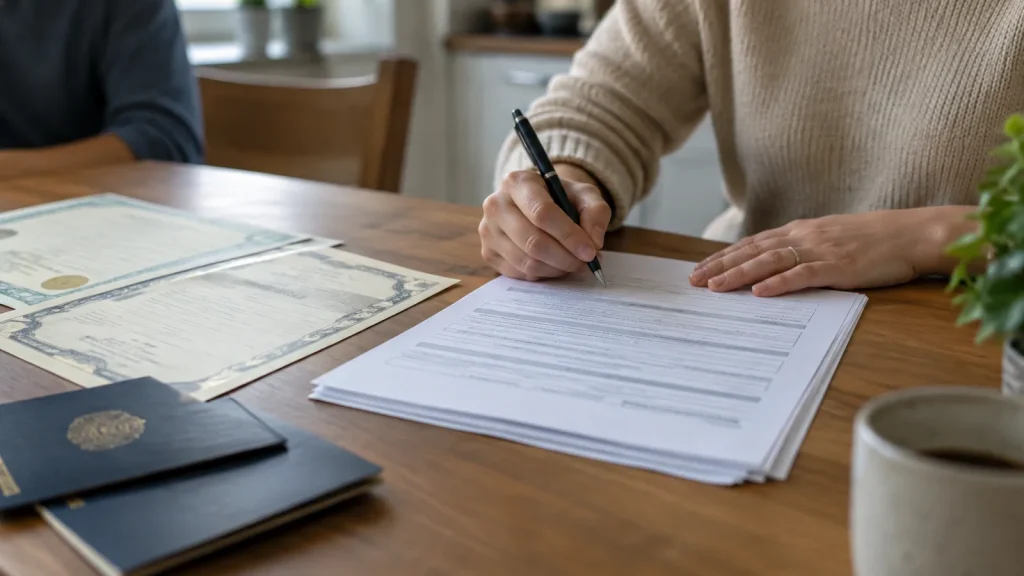
How to Fill Out Form I-130 - Step-by-Step Instructions and Sample
Form I-130 (Petition for Alien Relative) is the first document in almost every family-based immigration case to the US. A citizen or green card holder uses it to establish that a foreign national is their spouse, child, parent, sibling. Below is who files it on whom, what documents to gather beforehand, how to fill out […]

How to Fill Out Form I-864 - Sponsor Requirements, Income and Instructions
Form I-864 (Affidavit of Support) is the sponsor's financial guarantee in US family-based immigration. The relative who files it promises to support the immigrant if they cannot support themselves, and proves their income is enough to back that up. Without it, a family-based green card does not get issued. Below is who has to file […]
How to Get a CR1 or IR1 Visa for Your Spouse - Petition, Timeline and Cost